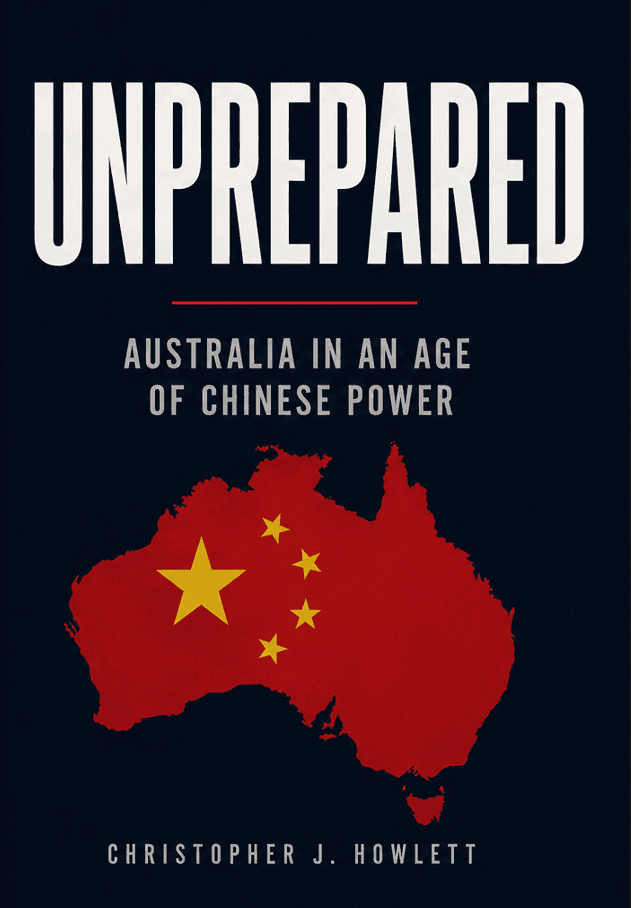
Unprepared — Australia in an Age of Chinese Power
The Argument

Unprepared

Australia in an Age of Chinese Power

Christopher J. Howlett

215,000 words · Eight pillars · Fifteen scenarios · A$200B per year

Synopsis

Australia faces the most dangerous strategic environment since the Second World War. China is building the largest military in Asia. The United States is distracted and its commitment uncertain. Australia's northern approaches are undefended. Its fuel reserves would last thirty-four days in a conflict. It imports eighty percent of its major defence equipment from countries it cannot guarantee access to.

And yet: Australia is rich enough, free enough, and favourably placed enough to change course — if it acts now. It sits above a mineral endowment that the world's great powers all need. Its democratic institutions remain intact. Its alliance relationships are deepening. Its geographic isolation, so often characterised as a weakness, is in fact a defender's dream in an age of missiles.

Unprepared makes the case for national transformation across eight interdependent pillars: resource revenue capture, wartime fiscal architecture, industrial re-shoring, demographic strategy, strategic decoupling from China, maritime and northern defence, alliance deepening, and regional architecture. The programme is costed at approximately A$200 billion per year in defence spending alone, funded through Norwegian-style resource revenue capture, and tested against fifteen divergent future scenarios.

The window to act is closing. This book argues it has not yet shut.

The Eight Pillars

The book makes the argument once. This platform makes it every day with fresh data. Every metric tracked here traces directly to a specific chapter and pillar in the book. When the news changes, the platform updates. When you adjust the simulator, you're running the book's model in real time.
Sources & basis — key figures (9)show ▾
Australia's fuel reserves would last thirty-four days in a conflict (34 days diesel, 32 days jet fuel, 36 days petrol).Energy Minister Chris Bowen to Parliament (reported Beef Central / Sheep Central), March 2026
Australia is below the IEA 90-day net-import stockholding obligation and imports ~90% of refined fuel; domestic days-of-cover are low. Corroborates the 34-day framing.Australian Govt DCCEEW — Measures of liquid fuel stocks; Fuel Security Act 2021 MSO, 2026
Australia is heavily dependent on foreign major defence equipment; ~80% of its arms imports (2019-23) came from a single supplier (the United States), with Spain next at 15% — concentration risk the book frames as '80% from countries it cannot guarantee access to.'SIPRI Trends in International Arms Transfers 2023 (Australia = 8th-largest arms importer, 3.7% of global imports; 80% of imports from US)
Australia still sources roughly 45% of defence procurement from imports (domestic share raised from ~45% to ~55%), confirming high import dependence for major platforms.US ITA Country Commercial Guide — Australia Defense; ASPI defence budget briefs, 2024-2026
The Programme is costed at approximately A$200 billion per year in defence spending alone (well above current actual spending of ~A$59B / ~2.1% of GDP in 2025-26). This is the book's recommended target, not current/announced policy.Unprepared — prescription
For context, actual Australian defence spending is ~A$59B (~2.13% of GDP) in 2025-26, with government trajectory to ~2.5% by 2033-34; US has pressed for 3.5% (~A$100B). The book's A$200B is far above all of these.ASPI, The Cost of Defence: Defence Budget Brief 2026-27
China is building the largest military in Asia; the PLA Navy is the world's largest navy with a battle force of 370+ ships, projected toward 395-435 by 2030.US DoD, Military and Security Developments Involving the PRC 2024 (China Military Power Report)
The programme is to be funded through 'Norwegian-style resource revenue capture' (a sovereign-wealth/royalty model). This is the book's recommended funding mechanism, not existing Australian policy.Unprepared — prescription
Book metadata: 215,000 words, eight pillars, fifteen scenarios.Unprepared — prescription

Lines citing “Unprepared — prescription” are the book's recommendation or target, not an external fact.