Victoria secures 15-year offtake agreement with 400 MW Baranduda battery
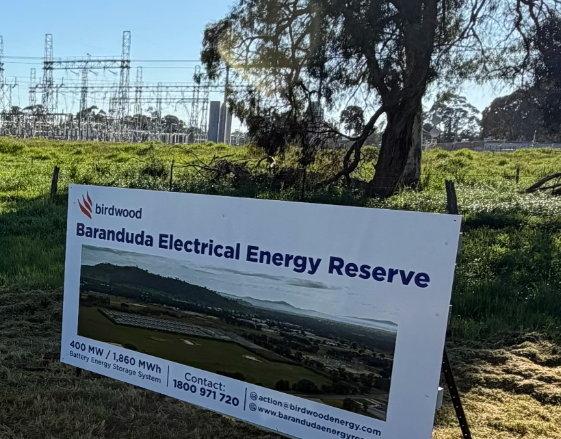
Victoria's State Electricity Commission has committed $43 million for a stake in the 400 MW Baranduda battery project, a 1.86 GWh facility being built near Wodonga. The 4.65-hour system is scheduled to begin operation in late 2028 and will be Victoria's largest battery by duration. The agreement, a 15-year offtake, is the first public-private partnership between the Victorian government and a superannuation fund for a renewable energy project. The battery sits adjacent to the critical Victoria-NSW interconnector.
Where this fits
This deal illustrates the whole-system cost of a renewables-only grid. A 400 MW battery with 4.65 hours of storage can hold 1.86 GWh: enough to supply evening peak demand for one night, not to cover weather-dependent supply across seasons. Victoria's 95% renewable target by 2035 requires not only wind and solar farms, but also massive investment in batteries for daily cycling and gas plants for seasonal gaps. The battery sits next to the interconnector because interstate firming, importing power from gas-fired generation elsewhere, is part of the unstated plan. This is not a weakness in the battery; it is a design feature of a grid that cannot firm itself.
What it means
Victoria is building a grid of weather-dependent sources that cannot stand alone. That complexity and cost, batteries, overbuilt transmission, gas standby, supply-chain dependence on China for lithium-ion cells and critical minerals, is the price of the political choice to exclude nuclear. A firm generation source with 60-year asset life and zero fuel risk would cost less over the grid's lifetime and eliminate sovereign dependence on commodity markets and foreign battery makers. Instead, Victoria is writing 15-year cheques for batteries that will degrade, age out, and need replacement within the infrastructure's operating horizon.
By the numbers
at ~A$600–1000/kWh installed. Source: BNEF, CSIRO GenCost 2024-25. Indicative.
of average national (NEM) demand if fully dischargeable, then it needs recharging. Storage shifts power, it does not generate it.
lithium, graphite, nickel, copper and cobalt (~186 t lithium content). Replaced roughly every 12 years. Source: IEA, Argonne GREET. Indicative.
~75% of cells are China-made. Source: IEA cell-manufacturing share.
enough for 1–2 TWh a year of firm, always-on power, generating for ~60 years. Source: CSIRO GenCost 2024-25 (A$8.5–13.2bn/GW), IAEA capacity factor.
Figures are indicative conversions from the article's stated quantity using published cost, material and capacity factors (CSIRO GenCost, BNEF, IEA, IAEA). Ranges, not precise forecasts.
Go deeper on the numbers
The bigger picture
Energy security is national security. This connects to the wider case at Unprepared: Australia's dependence on a strategic rival, and how ready it is for the world that is coming.
Reported by PV Magazine Australia. Read the original report ↗
Related coverage
Big battery durations are headed to double figures, and their chemistries are changing – again
Does Snowy 2.0 still have a place in a world of batteries? - ABC News & Headlines – Australian Broadcasting Corporation
Queensland energy plan assumes zero data centre demand - AFR
The power cable that could make or break Victoria - AFR
The numbers, as they move
A short, sourced brief when the figures shift: a transmission blow-out, a supply-chain move, a milestone.