We don’t want to lose the grey nomads: Town worries that oversize wind turbine loads will block caravan route
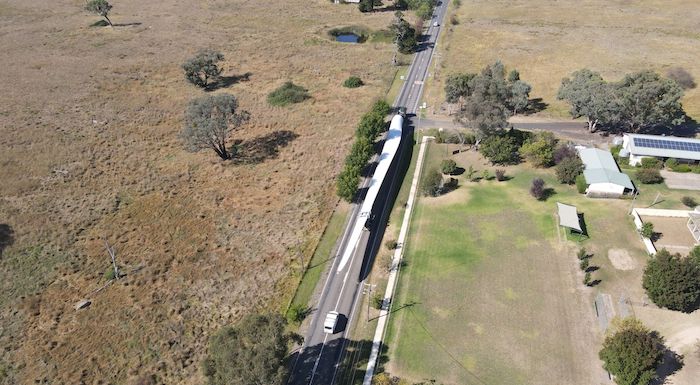
Balranald Shire Council has told the Independent Planning Commission it opposes modifications to roads near the town to accommodate delivery of wind turbine components for the 1.45 gigawatt Baldon wind project. The council supports the wind farm itself, but fears that heavy vehicle movements carrying 6.5-metre-wide tower sections will require removal of pedestrian traffic islands and road widening through town. The council's main worry is losing grey nomad tourism revenue if caravan routes are disrupted or slowed. Similar concerns have been raised by other regional councils managing multiple large wind projects in the South-West Renewable Energy Zone.
Where this fits
This is a whole-system cost that does not appear in megawatt-hour pricing. Wind turbine logistics, transport of massive blades and towers from port to site, requires civil works, road modification, and traffic management that falls on regional communities. The article shows a pattern: councils support renewables but face material costs (disruption, infrastructure wear, economic friction) that are externalized from the grid's accounting. This is part of the hidden infrastructure and coordination burden that the firm-power alternative, nuclear, avoids: a reactor arrives at a prepared site; no 90-metre blades roll through town.
What it means
Australia is building a renewable grid that depends on manufacturing and shipping supply chains across hostile geography, then absorbing the friction at the local level. The grey nomad economy is small, but it signals a real cost: each large wind project creates traffic shock waves through regional supply routes. As the transition scales, these frictions multiply. A firm, compact, site-concentrated generation source would spare these communities the burden while producing reliable, dispatchable power year-round.
By the numbers
at ~A$2000–3200/kW installed. Source: CSIRO GenCost 2024-25. Indicative.
at a ~38% capacity factor, and only when the wind blows, so it still needs firming.
enough for 2–4 TWh a year of firm, always-on power, generating for ~60 years. Source: CSIRO GenCost 2024-25 (A$8.5–13.2bn/GW), IAEA capacity factor.
Figures are indicative conversions from the article's stated quantity using published cost, material and capacity factors (CSIRO GenCost, BNEF, IEA, IAEA). Ranges, not precise forecasts.
Go deeper on the numbers
The bigger picture
Energy security is national security. This connects to the wider case at Unprepared: Australia's dependence on a strategic rival, and how ready it is for the world that is coming.
Reported by RenewEconomy. Read the original report ↗
Related coverage
'Worst of both worlds': sparse support for gas changes - Yahoo Finance Australia
Is Australia’s gas reservation scheme really aimed at Santos? - The Conversation
Gas now, pay later: industry to critique reservation - https://aapnews.aap.com.au/
CME pushes to lock in WA domestic gas exemption - The West Australian
The numbers, as they move
A short, sourced brief when the figures shift: a transmission blow-out, a supply-chain move, a milestone.