Agreement signed on second Polish nuclear power plant
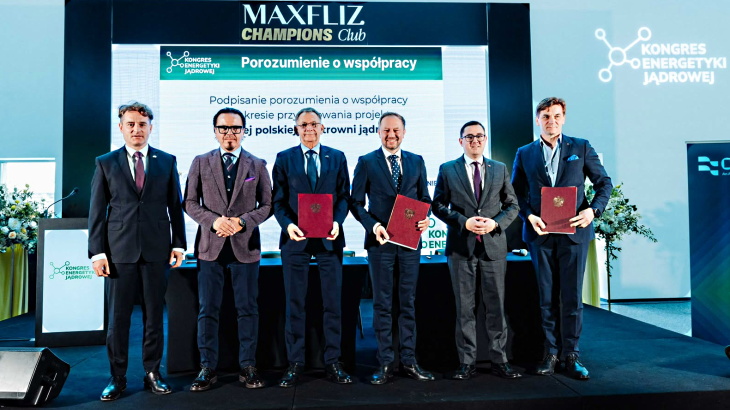
Poland's Ministry of Energy, state nuclear company Polskie Elektrownie Jądrowe (PEJ), and utility Polska Grupa Energetyczna (PGE) have signed an agreement to coordinate development of the country's second nuclear power plant. PGE will conduct site analysis and feasibility studies, while PEJ acts as investor and coordinator. Two sites, Bełchatów and Konin, are preferred locations. This follows an earlier agreement in May 2023 for the first reactor (3,750 MWe, using Westinghouse AP1000 technology) at Lubiatowo-Kopalino, with construction to begin in 2028. Poland's updated nuclear programme, adopted in September, targets six large reactors totalling 6, 9 GWe by 2040, with subsequent units deployed every 2, 3 years after the first unit's commissioning in 2033.
Where this fits
Poland is building firm, dispatchable power to reduce reliance on coal. The dual-site approach, first and second plants running in parallel preparation, signals serious commitment to nuclear as backbone generation rather than marginal capacity. This addresses the hard constraint that renewables alone cannot replace Poland's coal fleet without massive, costly transmission build and gas firming. The sovereignty point: Poland controls this supply chain through Western partners (Westinghouse, Bechtel) rather than depending on China for panels, batteries and inverters.
What it means
Australia faces the same coal-exit deadline but has chosen renewables-only, locking in dependence on Chinese manufacturing for solar, batteries and inverters, plus years of gas plant construction to firm weather-dependent output. Poland's parallel-site strategy compresses the timeline and accepts higher near-term cost to secure firm power and supply-chain sovereignty. Australia's ban on nuclear forecloses this option entirely, accepting lower firm capacity, higher whole-system cost, and strategic dependence as permanent features of the grid.
By the numbers
at ~A$2000–3200/kW installed. Source: CSIRO GenCost 2024-25. Indicative.
at a ~38% capacity factor, and only when the wind blows, so it still needs firming.
enough for 4–11 TWh a year of firm, always-on power, generating for ~60 years. Source: CSIRO GenCost 2024-25 (A$8.5–13.2bn/GW), IAEA capacity factor.
Figures are indicative conversions from the article's stated quantity using published cost, material and capacity factors (CSIRO GenCost, BNEF, IEA, IAEA). Ranges, not precise forecasts.
Go deeper on the numbers
The bigger picture
Energy security is national security. This connects to the wider case at Unprepared: Australia's dependence on a strategic rival, and how ready it is for the world that is coming.
Reported by World Nuclear News. Read the original report ↗
Related coverage
Nuclear Reactor Developers Target Indiana, Kentucky, for Sites and Customers
Australians believe nuclear should be part of nation’s energy future - Mining.com.au
South Korea Builds Reactors Fast; Licensing Slows Them Down
Slovakia connects Mochovce 4 nuclear unit to grid after brief delay - oEnergetice.cz
The numbers, as they move
A short, sourced brief when the figures shift: a transmission blow-out, a supply-chain move, a milestone.