Concrete foundations completed for all 18 turbines at first and smallest wind farm to begin construction this year
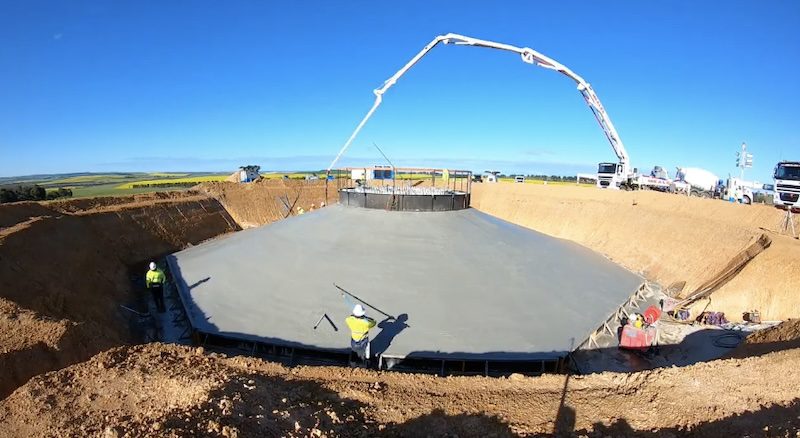
Tilt Renewables has completed pouring concrete foundations for all 18 turbines at the Waddi wind farm in Western Australia, a 108 MW project 150 km north of Perth. Each foundation used 105 tonnes of steel and 770 cubic metres of concrete, poured over 9 to 11 hours by teams of up to 32 workers. Waddi is the smallest of 10 wind farms that reached financial close in the past 12 months and began or are preparing construction. It is one of two Tilt projects under way, the other being Palmer in South Australia at 288 MW. Both have long-term offtake agreements with AGL and contracts under the federal Capacity Investment Scheme. Australia has started construction on 10 wind farms this year, with Western Australia hosting five projects either under construction or expansion.
Where this fits
Waddi exemplifies the materials and transmission cost hidden in headline capex. Each foundation demands roughly 24 cubic metres of concrete and 3 tonnes of steel per megawatt of capacity. Multiply that across the 10 wind farms under construction this year and the scale of embedded materials becomes clear: concrete foundations alone represent embodied carbon and supply-chain complexity that do not appear in the per-megawatt-hour cost. The broader pattern is that a renewables-heavy grid requires not just turbines but vast transmission infrastructure to move weather-dependent output across state lines, compounding the total capital requirement and the lock-in to China's supply chain for inverters, controls and grid-scale batteries needed to firm the variability.
What it means
Each completed foundation is a commitment to a weather-dependent generator that will require gas or battery firming for 70 to 80 per cent of its annual output. That firming cost and the transmission overbuild are the real price of decarbonisation on the renewables-only path. A nuclear plant of equivalent capacity would need far less concrete, steel, and transmission, and would deliver firm power regardless of wind speed, without the material or supply-chain footprint now being normalised as the cost of the transition.
By the numbers
at ~A$2000–3200/kW installed. Source: CSIRO GenCost 2024-25. Indicative.
at a ~38% capacity factor, and only when the wind blows, so it still needs firming.
Figures are indicative conversions from the article's stated quantity using published cost, material and capacity factors (CSIRO GenCost, BNEF, IEA, IAEA). Ranges, not precise forecasts.
Go deeper on the numbers
The bigger picture
Energy security is national security. This connects to the wider case at Unprepared: Australia's dependence on a strategic rival, and how ready it is for the world that is coming.
Reported by RenewEconomy. Read the original report ↗
Related coverage
More batteries, both big and small, mean solar farms don’t have to shut down so often - Renew Economy
Australia’s gas generation falls to lowest level since 2000 — OilPrice - UA.NEWS
Renewables Boom Pushes Australia's Gas Power to Quarter-Century Low - Crude Oil Prices Today | OilPrice.com
Taxpayers on the hook as Snowy delay threatens Tomago rescue - The Australian
The numbers, as they move
A short, sourced brief when the figures shift: a transmission blow-out, a supply-chain move, a milestone.