Supersized rooftop solar rebates go live in bid to tap into an 80 gigawatt goldmine
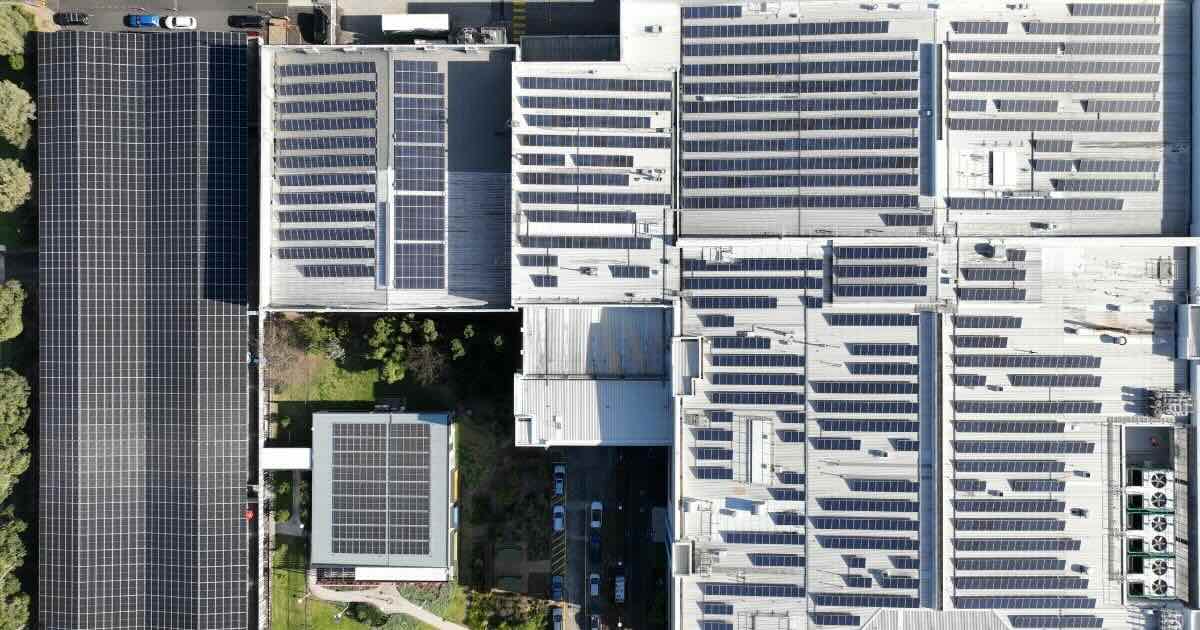
Australia's federal rooftop solar rebate has expanded to cover mid-scale systems between 100 kilowatts and 1 megawatt, offering roughly 20 per cent discounts on installation costs for farms, factories and commercial premises. The scheme, announced in August and live from October, targets an estimated 80 gigawatts of untapped rooftop capacity. The government projects a 250 kilowatt system could save a business $68,000 upfront and $50,000 annually on energy bills, while an 850 kilowatt system could receive around $232,000 in rebates.
Where this fits
The expansion addresses a genuine gap in Australia's solar deployment: commercial and industrial rooftops are cheaper to equip than utility-scale farms and require less land. Yet the policy amplifies the core structural problem of a renewables-heavy grid. More mid-scale solar means more weather-dependent capacity that will need firming, likely gas generation, and more transmission infrastructure to manage supply swings. It also deepens Australia's dependence on China's solar manufacturing and inverter supply chain, since the rebates make Chinese-made equipment cheaper to deploy while Australian industry has no domestic solar-panel or battery-cell capacity to speak of.
What it means
The rebates will accelerate rooftop-solar uptake among businesses that can afford upfront costs and have suitable premises, lowering their energy expenses in the short term. But the scheme does nothing to address the grid's growing need for firm, dispatchable power during low-sun periods, nor does it reduce Australia's supply-chain exposure to Beijing. A renewables grid built this way is cheaper at the margin but costlier at the system level: Australia is outsourcing both manufacturing risk and firming responsibility to gas and storage, when low-emission firm power, nuclear, remains legislatively banned.
By the numbers
at ~A$1100–1600/kW installed. Source: CSIRO GenCost 2024-25. Indicative.
at a ~24% capacity factor, and only when the sun shines, so it still needs firming.
~80% of modules are China-made. Source: IEA solar supply-chain data.
enough for 53–119 TWh a year of firm, always-on power, generating for ~60 years. Source: CSIRO GenCost 2024-25 (A$8.5–13.2bn/GW), IAEA capacity factor.
Figures are indicative conversions from the article's stated quantity using published cost, material and capacity factors (CSIRO GenCost, BNEF, IEA, IAEA). Ranges, not precise forecasts.
Go deeper on the numbers
The bigger picture
Energy security is national security. This connects to the wider case at Unprepared: Australia's dependence on a strategic rival, and how ready it is for the world that is coming.
Reported by RenewEconomy. Read the original report ↗
Related coverage
'Worst of both worlds': sparse support for gas changes - Yahoo Finance Australia
Is Australia’s gas reservation scheme really aimed at Santos? - The Conversation
Gas now, pay later: industry to critique reservation - https://aapnews.aap.com.au/
CME pushes to lock in WA domestic gas exemption - The West Australian
The numbers, as they move
A short, sourced brief when the figures shift: a transmission blow-out, a supply-chain move, a milestone.