Third unit at Changjiang site commissioned
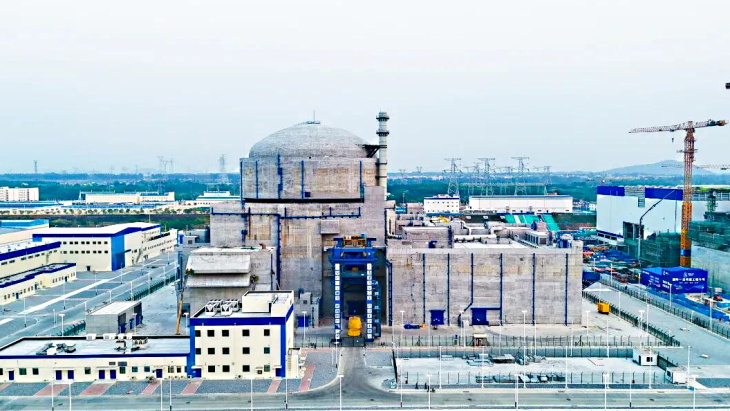
China's Changjiang nuclear station in Hainan province has brought unit 3 online, a Hualong One (HPR1000) reactor that achieved first criticality on 10 July and connected to the grid on 1 August. Unit 4 is scheduled for early 2027. The two-unit Phase II project, a CNY40 billion investment, will generate 18 billion kilowatt-hours annually and displace 6.32 million metric tons of coal equivalent per year. This is the first large-scale reactor that China Huaneng has built and operated as controlling shareholder. The site already hosts two operating 600 MWe PWRs (commissioned 2015 and 2016) and is undergoing pre-commissioning of a small modular reactor demonstration unit.
Where this fits
This demonstrates China's strategic commitment to firm, low-emission generation at scale and pace. While Australia debates whether nuclear should be legal, China is operationalising its second domestic reactor design, building redundancy into its supply chain and proving the Hualong One commercially. The HPR1000 is not Australian technology, nor will it be: China's nuclear industry is now a sovereign competitor, not a customer of Western designs. This matters because Australia's renewable-plus-gas transition leans on Chinese solar panels, batteries and inverters for its bulk generation, while forgoing the one firm, energy-dense, low-emission alternative that China treats as strategic infrastructure.
What it means
China is decoupling from energy dependence through nuclear capacity. Australia is deepening dependence on China for the materials and components that anchor its transition pathway. The gap widens: China has the industrial base, supply chain sovereignty and political will to build firm power. Australia has neither the legal framework nor the manufacturing base to follow, and is instead betting on firming a renewables grid with gas and imported batteries in a decade when both could be constrained.
By the numbers
enough for 5–8 TWh a year of firm, always-on power, generating for ~60 years. Source: CSIRO GenCost 2024-25 (A$8.5–13.2bn/GW), IAEA capacity factor.
Figures are indicative conversions from the article's stated quantity using published cost, material and capacity factors (CSIRO GenCost, BNEF, IEA, IAEA). Ranges, not precise forecasts.
Go deeper on the numbers
The bigger picture
Energy security is national security. This connects to the wider case at Unprepared: Australia's dependence on a strategic rival, and how ready it is for the world that is coming.
Reported by World Nuclear News. Read the original report ↗
Related coverage
Nuclear Reactor Developers Target Indiana, Kentucky, for Sites and Customers
Australians believe nuclear should be part of nation’s energy future - Mining.com.au
South Korea Builds Reactors Fast; Licensing Slows Them Down
Slovakia connects Mochovce 4 nuclear unit to grid after brief delay - oEnergetice.cz
The numbers, as they move
A short, sourced brief when the figures shift: a transmission blow-out, a supply-chain move, a milestone.