Bangladesh's Rooppur 1 supplies country's first nuclear energy
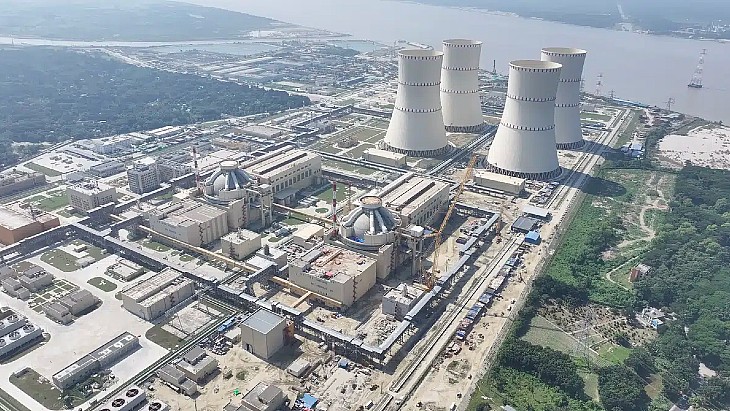
Bangladesh's first nuclear unit, Rooppur 1, was connected to the national grid on 17 November 2026 and supplied its first electricity. The trial lasted 8-10 hours at reduced output, around 350 MWe of the unit's full 1,200 MWe capacity. The plant will undergo further disconnection and reconnection cycles over the coming weeks to complete technical and stability tests before entering commercial operation. Each of the two units at Rooppur is designed for 1,200 MWe. The project is built by Rosatom, Russia's state nuclear corporation.
Where this fits
Rooppur 1 represents firm, dispatchable power entering a grid that has relied on seasonal monsoon hydro and an increasingly weather-dependent renewable mix. A 1,200 MWe nuclear unit runs at full capacity regardless of wind or sun, eliminating the need for gas peaking plants or battery storage to cover output volatility. This is the form of generation Australia has banned by law, while building a renewables-heavy grid that requires expanding gas capacity and transmission networks to manage intermittency. Bangladesh's choice to build nuclear signals that countries viewing energy security as non-negotiable are not waiting for a renewables-only pathway to mature.
What it means
Australia's energy policy locks in dependence on gas for firming, Chinese supply chains for panels and batteries, and a transmission overbuild to shuffle weather-dependent power across distance. Rooppur demonstrates that the firm-power alternative, low material intensity, low lifecycle emissions, and Australian uranium, remains available to any country with the political will to use it. The gap between Australian law and the choices made by other developing nations underscores that the renewables-only grid is a choice, not an inevitability.
By the numbers
at ~A$2000–3200/kW installed. Source: CSIRO GenCost 2024-25. Indicative.
at a ~38% capacity factor, and only when the wind blows, so it still needs firming.
enough for 1–4 TWh a year of firm, always-on power, generating for ~60 years. Source: CSIRO GenCost 2024-25 (A$8.5–13.2bn/GW), IAEA capacity factor.
Figures are indicative conversions from the article's stated quantity using published cost, material and capacity factors (CSIRO GenCost, BNEF, IEA, IAEA). Ranges, not precise forecasts.
Go deeper on the numbers
The bigger picture
Energy security is national security. This connects to the wider case at Unprepared: Australia's dependence on a strategic rival, and how ready it is for the world that is coming.

A Lie Told in the Rose Garden
On September 25, 2015, Xi Jinping promised in the White House Rose Garden that China would not militarise its artificial islands. Part VI of the Unprepared series.
Reported by World Nuclear News. Read the original report ↗
Related coverage
Bowen’s anti-nuclear power spin reduces his office to that of a TikTokker - News24
Nuclear microreactor sparks energy debate - ABC News & Headlines – Australian Broadcasting Corporation
The line that Australia’s nuclear power ban was never properly debated is, frankly, bullshit
Queensland MP renews push to lift Australia nuclear moratorium after microreactor milestone - Traders Union
The numbers, as they move
A short, sourced brief when the figures shift: a transmission blow-out, a supply-chain move, a milestone.