New nuclear projects offer economic advantages for Ontario
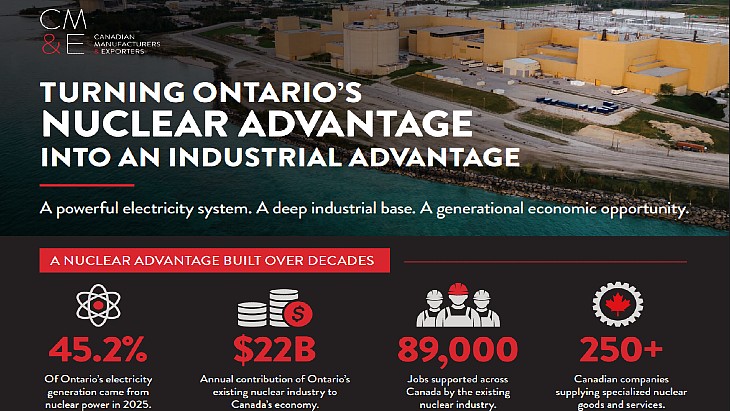
The Canadian Manufacturers & Exporters released a report quantifying economic benefits from four Ontario nuclear projects: Darlington small modular reactors, Pickering refurbishment, and potential new builds at Bruce C and Wesleyville. The four projects are projected to contribute CAD882 billion to national GDP and generate 3.45 million job-years, with CAD806.1 billion and 2.94 million job-years staying in Ontario. The Darlington SMR project, now under construction, is expected to add CAD38.5 billion to national GDP, with all four units operational by the mid-2030s. Pickering refurbishment began in September.
Where this fits
This validates the firm-power case against renewables-only paths. Ontario is building out the energy-dense, low-material alternative that Australia has legislatively barred, capturing not just generation but industrial supply-chain capacity that Australia outsources to China. The report treats nuclear as infrastructure investment with multiplier effects across manufacturing and employment. Australia's grid transition, by contrast, leans on weather-dependent capacity that requires gas firming, transmission overbuild, and imported panels and batteries from China's coal-powered factories. The sovereignty cost of that choice is invisible in most Australian energy policy.
What it means
Australia watches Ontario lock in firm, long-lived generation while building domestic industrial capability. Meanwhile Australia's 10-year transmission build, battery capacity, and panel supply remain tethered to Chinese supply chains and subject to cost escalation or strategic leverage. The question is not whether nuclear works. It is whether Australia will accept dependence on a competitor's manufacturing base and weather-dependent firming costs to avoid a technology its nearest peer is now scaling as industrial strategy.
By the numbers
enough for 527–818 TWh a year of firm, always-on power, generating for ~60 years. Source: CSIRO GenCost 2024-25 (A$8.5–13.2bn/GW), IAEA capacity factor.
Figures are indicative conversions from the article's stated quantity using published cost, material and capacity factors (CSIRO GenCost, BNEF, IEA, IAEA). Ranges, not precise forecasts.
Go deeper on the numbers
The bigger picture
Energy security is national security. This connects to the wider case at Unprepared: Australia's dependence on a strategic rival, and how ready it is for the world that is coming.

A Lie Told in the Rose Garden
On September 25, 2015, Xi Jinping promised in the White House Rose Garden that China would not militarise its artificial islands. Part VI of the Unprepared series.
Reported by World Nuclear News. Read the original report ↗
Related coverage
Bowen’s anti-nuclear power spin reduces his office to that of a TikTokker - News24
Nuclear microreactor sparks energy debate - ABC News & Headlines – Australian Broadcasting Corporation
The line that Australia’s nuclear power ban was never properly debated is, frankly, bullshit
Queensland MP renews push to lift Australia nuclear moratorium after microreactor milestone - Traders Union
The numbers, as they move
A short, sourced brief when the figures shift: a transmission blow-out, a supply-chain move, a milestone.