Warning Time
Welcome to the first edition
I wasn't quite ready to go with the first newsletter yet, but this was one of the most significant weeks in Australian geopolitical news in recent months, and felt it deserved preserving. Please forgive me if there are any teething pains.
First up, the big one…
China's Pacific SLBM Test Signals a New Phase in Undersea Nuclear Competition
On Monday, China test-launched a submarine-launched ballistic missile into the Pacific, its first-ever strategic SLBM test in international waters. A nuclear-powered submarine, deep in the Pacific, demonstrating reach. The same day, Prime Minister Albanese was in Fiji signing a new mutual defence pact. The timing was not coincidence. It was deliberate.
Here's what that means. China wanted the world to see that while Australia was scrambling to build regional alliances, Beijing can project power directly into the Pacific whenever it chooses. The message to Fiji, to the Pacific Islands, to Australia: we are present, we are capable, and your new security arrangements won't stop us. This is a direct escalation of the ongoing grey-zone intimidation I have been tracking and charting on the website
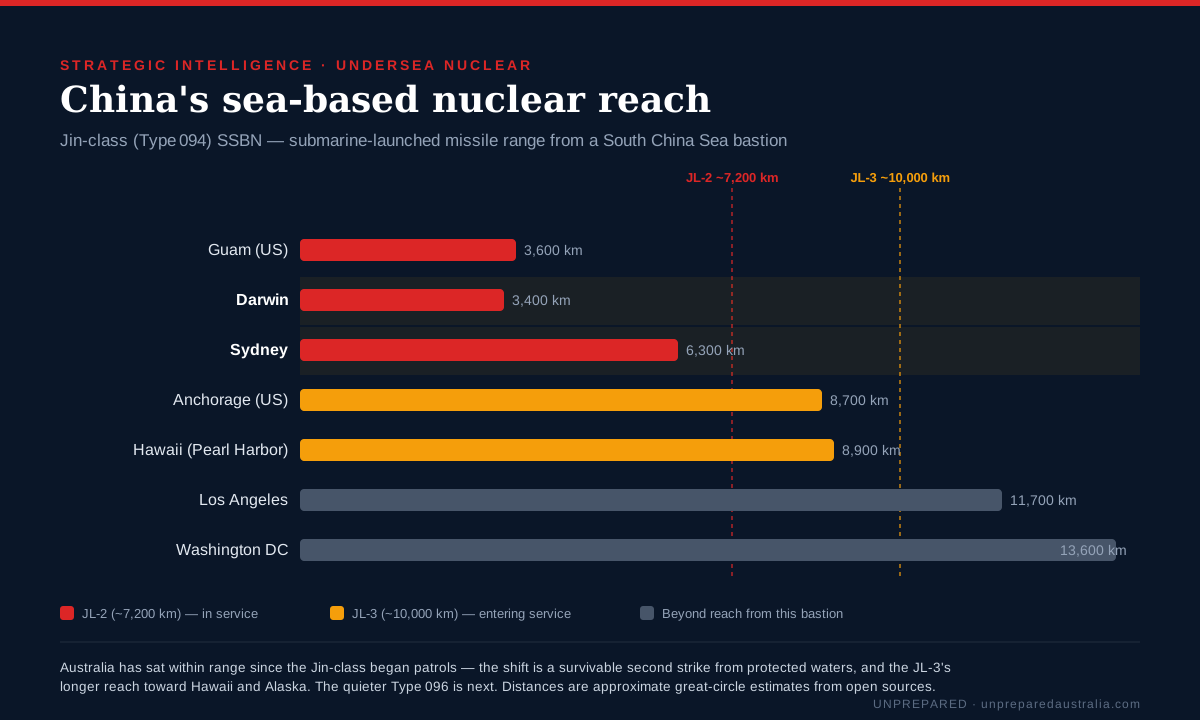
The Fiji pact itself is strategically sound. It guarantees mutual defence, opens the door to closer military cooperation, and signals to the Pacific that Australia is serious about keeping the region free from coercion. The only problem is this: Australia cannot actually defend Fiji against Chinese aggression in its current state. We lack the force structure, the readiness, the industrial base, and the strategic depth to guarantee the security of another nation while we're unprepared to guarantee our own. We've made a commitment we don't yet have the capacity to keep.
We must ask ourselves – if the CCP came knocking, what would Australia do? What would Fiji do? And what can Australia do?
Against what, exactly? China now has submarine-launched ballistic missiles that can reach into the Pacific. We don't know how many Jin-class SSBNs are in the region at any given time, but the capability is real and growing. If one of those submarines shows up off the Australian coast during a crisis and threatens nuclear escalation, what do we do? The answer, uncomfortable as it is, depends entirely on the American nuclear umbrella. Australia has no defence against a submarine-launched ballistic missile. None. We are entirely reliant on the United States' second-strike doctrine to deter Chinese nuclear blackmail. That's not a failing of current defence policy — it's a fact of physics and geography. But it's a fact that makes the AUKUS commitment, the rotations of American and British submarines through Perth, and the deepening of alliance integration non-negotiable.
Meanwhile, across the Tasman and into the subcontinent
Prime Minister Modi was in Australia this week, and the two countries signed eighteen major agreements spanning defence, maritime security, energy, and critical technology. A defence industrial corridor. Logistics cooperation. Joint military exercises — Pitch Black 2026 will field over 100 aircraft from 20 nations, including Indian Air Force combat missions over the Northern Territory. P-8 maritime patrol jet cooperation. Critical minerals partnerships, lithium and uranium flowing to India so they can build their economy and secure their energy independence.
Here's the question that should keep us awake: in thirty years, will Australia be reliant on India the way we're currently reliant on the United States? If we don't transform our defence posture, our industrial base, and our strategic independence in the next decade, that's exactly where we'll be. Dependent on a succession of stronger powers to bail us out. Modi's visit is good strategy. India is a natural partner in the Indo-Pacific. But it's also a mirror: India is buying Australian uranium to fuel nuclear power plants that will secure Indian energy independence. Meanwhile, Australia's electricity grid is fracturing. Power prices are through the roof, strangling business competitiveness and making innovation prohibitively expensive. And nuclear power — the one technology that could solve this permanently — is still banned, still ridiculed by the political left, still treated as a third-rail by the Albanese Labor government.
How is it that we can champion another country buying our uranium to secure their energy independence, but we won't use that same uranium to secure our own?
The answer is political cowardice and strategic delusion.
The infrastructure that holds us together is thinner than we think
On Wednesday, Telstra's mobile network went down across Australia. Australians couldn't make calls, couldn't access emergency services reliably, couldn't do business. Banks seized up. Hospitals went manual. Traffic lights failed. Train services were disrupted. This was an error of our own making.
Now think about what that means in the context of actual conflict. Taiwan has just released analysis showing that any Chinese invasion would begin with coordinated cyber attacks on critical infrastructure — power grids, water systems, communications, financial systems.
The Telstra outage was an accident. Imagine the same impact delivered deliberately, coordinated across multiple networks and systems simultaneously, persisting not for hours but for days, during a crisis when you actually need those systems to function. That's the scenario Australia needs to plan for. And based on what we saw this week, we're catastrophically underprepared.
China's cyber capabilities are sophisticated and growing. They've already probed Australian infrastructure. If we can do this to ourselves, just imagine what the CCP can and will do to us in a time of conflict, especially if we consider the likelihood that a lot of systems are already compromised.
Cyber resilience isn't something Australia can outsource to America. It requires hardened systems, redundancy, civil defence planning, critical infrastructure protection that actually functions. It requires treating cyber as a domain of active ongoing conflict, not a future threat.
In Case You Missed It
Solomon Islands deepening ties with Australia. Following the momentum of the Fiji pact, Australia and the Solomon Islands are in active negotiations on a comprehensive bilateral defence treaty. Australia is systematically locking in Pacific partnerships. The question is whether it can actually deliver on the commitments those partnerships entail.
Words versus reality in the South China Sea. The US, UK, Australia, and twelve other nations reaffirmed the 2016 UN tribunal ruling invalidating China's claims in the South China Sea. It was a show of legal and diplomatic solidarity. It was also entirely meaningless. China continues to militarise the South China Sea to its heart's content, fortifying reefs and expanding military facilities regardless of what any tribunal or coalition of nations declares. This is the problem with appeasement, words mean nothing, and meanwhile The CCP marches on.
HMAS Sydney on regional presence. The destroyer HMAS Sydney departed for regional presence operations, participating in RIMPAC in the United States before continuing through the Indo-Pacific for training and engagements with regional partners. Necessary, but thin relative to the scale of the challenge.
Japan's military compromised by Chinese malware. Japan's Ground Self-Defense Force unknowingly used counterfeit USB drives infected with China-linked malware on computers with access to classified military information for nearly a year. The drives were distributed during earthquake relief operations. If it can happen to Japan, it can happen to Australia. And probably already has.
Space partnership with India. Australia committed a space tracking terminal on the Cocos Islands to support India's Gaganyaan space programme, expanding the technology partnership between the two nations.
China tightens the critical minerals noose. Beijing added ten US firms to its export-control list on 22 June, naming MP Materials and USA Rare Earth. This is coercion via critical minerals, the same weapon Australia felt in 2020, now aimed squarely at Washington's supply chains.
Diesel reserves keep sliding. Australia's diesel stockpile fell to 31 days of cover, down from 34 the previous quarter. Fuel security remains a chronic, unaddressed exposure — the kind of vulnerability that turns into a crisis the moment supply lines are disrupted.
Australia's first domestic GMLRS production confirmed. Test-fired in April, this is genuine industrial-base progress — proof that sovereign missile manufacturing is possible when the political will exists. More of this, faster.
A cautious hand back to France. Five years after AUKUS fractured the relationship, Australia is extending renewed defence engagement to France. Portfolio-balancing, not a pivot — but a sign Canberra understands the cost of having too few partners.
Henderson and the shipbuilding question. The Henderson Defence Precinct in Western Australia is being flagged as central to AUKUS submarine construction and maintenance. Whether it can scale fast enough is the real test.
See you next week!