From Desert Storm to the world's largest navy
In 1991 the People's Liberation Army watched its own obsolescence on live television. Thirty-five years later it has the largest navy on earth, the leading hypersonic arsenal, and an industrial base no one can match. Part III of the Unprepared series.

On the evening of January 17, 1991, the People's Liberation Army watched its own obsolescence unfold on live television. Operation Desert Storm had begun, and over the following forty-two days the American-led coalition dismantled what had been the world's fourth-largest military with a speed and precision that no one in Beijing had predicted. Iraqi armoured columns equipped with Soviet T-72 tanks, the same generation of equipment that formed the backbone of China's own ground forces, were incinerated by laser-guided bombs dropped from aircraft the defenders could neither see nor track. Iraqi air defences built around SA-6 systems, comparable to what China fielded along its own coastline, were suppressed within hours. MiG-29 fighters, more advanced than anything in the PLA Air Force inventory, were shot down without ever engaging their attackers. Over a hundred thousand sorties were flown, 88,500 tonnes of ordnance delivered, and more than three thousand Iraqi tanks destroyed at a cost of thirty-one coalition tanks lost. On the night of February 26, American aircraft trapped an Iraqi convoy retreating along Highway 80 out of Kuwait and destroyed between 1,400 and 2,000 vehicles in a single sustained engagement that became known as the Highway of Death.
The Chinese military's reaction was not merely surprise. It was something closer to existential shock. PLA Second Artillery officer Liu Dingping later recalled that most Chinese military personnel had predicted the United States would repeat the Soviet Union's failure in Afghanistan, bogged down in a long war of attrition against a determined regional power. They were wrong, and the scale of how wrong they were was impossible to rationalise. Senior Colonel Wang Baocun, writing in Liberation Army Daily in 1995, identified what he called ten defining features of the new warfare: limited objectives, short duration, battlefield transparency, unprecedented force integration, and above all, the dominance of precision over mass. Shanghai-based military researcher Ni Lexiong was more direct: if it had been China being attacked by the Americans at that time, the result would not have been any better. Internal PLA assessments concluded that China's weapons were thirty to forty years behind Western standards, and that the entire doctrinal framework on which the PLA had been built, Mao's concept of People's War, was as dead as the Iraqi tanks burning on the highway to Basra.
What made the Gulf War so devastating for Chinese strategic thinking was not just the outcome but the mechanism. The United States had not won through superior numbers or greater willingness to absorb casualties. It had won through information, precision, stealth, and the integration of systems that could see everything, communicate instantly, and strike with accuracy that rendered mass irrelevant. The PLA's entire theory of war, which held that a large, ideologically motivated force could defeat a technologically superior enemy through sheer numbers and willpower, had been tested by proxy and found to be a fantasy. Chinese analysts described Desert Storm as the epitome of information warfare, and within two years the implications had reached the highest levels of strategic decision-making.
In January 1993, CMC Chairman Jiang Zemin introduced the Military Strategic Guidelines for the New Period at an enlarged Central Military Commission meeting, formally replacing preparations for People's War with a new doctrine: winning local wars under modern, high-technology conditions. This was the most significant Chinese doctrinal shift since 1949. It meant the PLA would abandon preparations for total war against the Soviet Union, which no longer existed, and instead prepare for short, high-intensity conflicts on its periphery, above all over Taiwan. The guidelines prioritised air and naval forces over the ground army, demanded precision-strike capabilities and networked command-and-control systems, and reoriented China's primary threat axis from the northern border to the Taiwan Strait and western Pacific.
Two years later, the humiliation was compounded. When President Clinton granted a visa to Taiwan's Lee Teng-hui to visit Cornell University in June 1995, Beijing responded with escalating military provocations, firing missiles thirty-six miles north of Taiwan in July and then bracketing the island with shots just twenty miles off Keelung and twenty-nine miles off Kaohsiung, Taiwan's two principal ports, in March 1996. Washington's response was to deploy the USS Nimitz and USS Independence carrier battle groups to waters near Taiwan, the largest American naval demonstration against China since the 1950s. The PLA could do nothing. Its navy was a coastal defence force of aging patrol boats and Romeo-class submarines, utterly incapable of contesting two carrier strike groups operating with impunity in what Beijing considered its own waters. PLA Deputy Chief of General Staff Lieutenant General Xiong Guangkai reportedly told a former American defence official that in the end, Americans cared more about Los Angeles than about Taipei. The bravado masked total impotence.
Jiang Zemin ordered a ten-year modernisation programme and launched Project 995 to accelerate weapons development. Within months, China placed its first order for two Sovremenny-class destroyers from Russia, ships armed with SS-N-22 Sunburn supersonic anti-ship missiles specifically designed to kill aircraft carriers. The direct line from the Taiwan Strait humiliation to everything that followed, the Russian shopping spree, the technology theft, the shipbuilding surge, the anti-ship ballistic missile programme, the stealth fighter, the hypersonic arsenal, runs unbroken from that moment in March 1996 when two American carriers sailed into the strait and a nuclear-armed nation of 1.2 billion people discovered it could not make them leave.
Two American carriers sailed into the strait and a nuclear-armed nation of 1.2 billion people discovered it could not make them leave.
Buying, stealing, building
China's response to the Gulf War shock and the Taiwan Strait humiliation was pursued on two tracks simultaneously, and understanding both is essential to grasping the speed of what followed. The first track was to buy, immediately and in enormous quantities, the most advanced weapons systems that Russia was willing to sell. The second was to steal, systematically and on an industrial scale, the military technologies that no one was willing to sell at all.
The Russian shopping spree was driven by desperation on both sides. Russia's defence industry was collapsing in the post-Soviet chaos of the 1990s, factories were closing, engineers were going unpaid, and the Kremlin needed hard currency. China needed modern weapons it could not yet build for itself and was willing to pay handsomely. Between the early 1990s and the mid-2000s, China spent more than twenty billion dollars on Russian military hardware, and the purchases transformed every branch of the PLA almost overnight.
The centrepiece of the naval acquisitions was the Sovremenny-class destroyer. China ordered four in two batches, the first two Project 956E ships delivered in 1999 and 2000 at roughly five hundred million dollars each, followed by two improved Project 956EM ships by 2006. Each displaced approximately eight thousand tonnes and carried eight SS-N-22 Sunburn supersonic anti-ship missiles, weapons that travelled at Mach 3 in a sea-skimming flight profile with violent terminal manoeuvres designed to overwhelm the close-in defence systems of American warships. These were not general-purpose vessels. They were carrier-killers, purchased specifically because the Taiwan Strait crisis had demonstrated that China could not contest American naval power with anything in its existing inventory.
Beneath the surface, China acquired twelve Kilo-class diesel-electric submarines in three batches, the later eight being improved Project 636M boats ordered in 2002 for approximately 1.6 billion dollars. The final variants carried Club-S cruise missiles with a 220-kilometre anti-ship range and a supersonic terminal phase, giving China its first credible undersea anti-ship capability. In the air, China purchased twenty-six Su-27SK fighters in its first deal for roughly one billion dollars, followed by additional batches and a landmark licensing agreement around 1995 to 1996 that granted Shenyang Aircraft Corporation the rights to co-produce two hundred Su-27s domestically for 2.5 billion dollars. A further hundred Su-30MKK and MK2 multirole fighters were delivered between 2000 and 2004. For air defence, China acquired multiple batteries of S-300 surface-to-air missile systems beginning in 1993, eventually deploying approximately forty batteries around Beijing, Shanghai, and the Taiwan-facing Fujian coast.

The licensing agreements revealed something important about China's long-term intentions. Shenyang assembled roughly 105 Su-27s under licence before abruptly cancelling the contract in 2004, claiming the aircraft no longer met its requirements. Three years later, it unveiled the J-11B, a fighter built without any Russian involvement, with ninety per cent indigenous components, but an essentially identical airframe. Russia was furious but powerless, because China accounted for roughly forty per cent of its military export revenue. The pattern would repeat across multiple programmes: purchase a system, learn how it works, reverse-engineer the critical components, then build an indigenous version and cancel further orders. It was technology acquisition through commerce, and it was devastatingly effective.
The second track was espionage, and it operated at a scale that Western intelligence agencies would take years to fully appreciate. The Cox Report, published by the United States Congress in 1999, alleged that China had stolen design information on America's most advanced thermonuclear warheads, particularly the W-88 miniaturised warhead for the Trident II submarine-launched missile. The investigation centred on Los Alamos National Laboratory and generated enormous controversy, though its most dramatic claims were substantially contested. More clear-cut was the case of Chi Mak, a Chinese-born engineer at a Navy defence contractor arrested in October 2005 and convicted of stealing sensitive Quiet Electric Drive submarine propulsion technology. Chi was believed to have been a sleeper agent dispatched to the United States in the late 1970s. He was sentenced to more than twenty-four years in federal prison.
The F-35 Joint Strike Fighter programme was penetrated through cyber intrusion. Su Bin, a Chinese businessman operating from Canada, conspired with two PLA officers between 2008 and 2014 to steal 630,000 files totalling sixty-five gigabytes from Boeing, including data on the C-17 Globemaster transport and both the F-22 and F-35 stealth fighters. Western analysts have noted the striking resemblance between the stolen F-35 data and China's subsequently developed J-31 and J-35 carrier-based stealth fighter. Dongfan "Greg" Chung, a Boeing engineer, accumulated three hundred thousand pages of classified material over thirty years on the Space Shuttle, Delta IV rocket, and C-17, receiving a sentence of nearly sixteen years. Noshir Gowadia, a principal designer of the B-2 stealth bomber's propulsion system, helped China design a low-signature cruise missile exhaust nozzle to evade infrared detection and received thirty-two years.
The cyber dimension of technology theft eventually dwarfed the human espionage programme. In February 2013, the cybersecurity firm Mandiant published a landmark report publicly attributing the APT1 hacking group to PLA Unit 61398, a signals intelligence unit operating from a twelve-storey building in Shanghai's Pudong district. The unit had compromised 141 companies across twenty industries, stealing hundreds of terabytes of data. It was one of at least twenty PLA-linked advanced persistent threat groups identified by Western intelligence, and it represented only the visible edge of an industrial-scale cyber espionage campaign that had been running for more than a decade.
The EP-3 incident of April 2001 illustrated both the aggression and the appetite. A PLA J-8II fighter collided with a US Navy EP-3E signals intelligence aircraft seventy miles off Hainan Island, killing the Chinese pilot and forcing the American plane to make an emergency landing at Lingshui airfield with its crew of twenty-four. The crew had twenty-six minutes to destroy sensitive equipment before Chinese military personnel boarded the aircraft. They poured coffee into disk drives and used an emergency axe that proved too blunt, failing to destroy cryptographic keys, signals intelligence manuals, and classified personnel records. Chinese technicians spent the eleven days of the crew's detention thoroughly stripping and examining the aircraft's intelligence equipment. The Americans got their people back. China got a close look at the electronic systems it most wanted to understand.
What distinguished China's technology acquisition strategy from ordinary espionage was its comprehensiveness and its integration with legitimate commercial activity. It was not a matter of isolated agents stealing individual secrets. It was a national programme, coordinated across intelligence services, military units, state-owned enterprises, and academic institutions, designed to hoover up everything from warhead designs to submarine propulsion to stealth coatings to radar systems to jet engine metallurgy. The stolen knowledge did not sit in filing cabinets. It was fed directly into indigenous weapons programmes that were themselves scaling up at extraordinary speed. By the mid-2000s, the results were beginning to appear: China's first modern indigenous destroyers, its first credible submarine-launched ballistic missile, the early prototypes of what would become the J-20 stealth fighter, and the initial development of the DF-21D anti-ship ballistic missile that would eventually be called the carrier killer. The PLA that had watched Desert Storm in horror was becoming something very different, and it was doing so faster than anyone in the West had expected.
Xi Jinping and the purge that built an army
The transformation described above was real but incomplete. By the time Xi Jinping assumed power as both CCP General Secretary and Central Military Commission Chairman on November 15, 2012, an unusual move in itself since Hu Jintao had waited two years before receiving the military chair, the PLA was qualitatively better than it had been in 1991 but still plagued by institutional rot that no amount of Russian hardware or stolen blueprints could fix. The officer corps was riddled with corruption so endemic that promotions were literally bought and sold. The command structure was a relic of the 1950s, organised around seven military regions designed to fight a Soviet land invasion that was never going to come. The army still dominated resource allocation despite the doctrinal shift toward naval and air power. And the vast commercial empire that Deng had authorised in the 1980s had been only partially dismantled, with informal business interests continuing to distract senior officers from their actual purpose. Xi's contribution to the PLA's transformation was not primarily technological. It was organisational, political, and ruthless.
The anti-corruption purge came first, and its scale was without precedent in modern Chinese military history. Xi's primary targets were the two most senior military officers of the preceding era: General Xu Caihou and General Guo Boxiong, both former Vice Chairmen of the Central Military Commission and both loyalists of former leader Jiang Zemin. Xu had run what amounted to a cash-for-ranks syndicate in which officers paid enormous bribes for promotions, with the money flowing upward through a network of intermediaries. He was expelled from the Party on June 30, 2014 and died of bladder cancer in custody on March 15, 2015 before standing trial. Guo Boxiong, who had operated a parallel corruption network during his tenure as the most senior military officer in the country, was sentenced to life imprisonment on July 25, 2016 for taking what the court described as exceptionally huge amounts in bribes, estimated at eighty million yuan. The purge did not stop at the top. CMC Political Work Department Director Zhang Yang was found dead in his home on November 23, 2017, an apparent suicide while under investigation. Joint Staff Department Chief Fang Fenghui, a sitting CMC member, was placed under investigation in August 2017. In total, more than eighty senior officers were brought down between 2012 and 2016, and the purges continued sporadically thereafter, with at least fifteen high-ranking military officials and defence industry executives removed in late 2023 alone, including former Defence Minister Li Shangfu, who had overseen all PLA weapons acquisitions from 2017 to 2022.
The corruption purge served two purposes simultaneously. It cleaned out a command structure in which professional competence had been subordinated to patronage networks and personal enrichment, and it consolidated Xi's personal control over the military to a degree not seen since Mao. By removing the Jiang Zemin loyalists who had dominated the senior ranks for a decade, Xi ensured that every officer who rose to replace them owed his position to Xi personally. The PLA that emerged from the purge was both cleaner and more obedient, which was precisely the combination Xi needed for what came next.
The structural reforms announced at a CMC Reform Work Conference in November 2015 and implemented from February 1, 2016 were the most sweeping military reorganisation since the founding of the People's Republic. The seven military regions, which had functioned as semi-autonomous fiefdoms with their own ground, naval, and air components, were replaced by five theatre commands: Eastern, headquartered in Nanjing and responsible for the Taiwan Strait; Southern, in Guangzhou, covering the South China Sea; Western, in Chengdu, facing India and Central Asia; Northern, in Shenyang, covering Korea and the Russian border; and Central, in Beijing, serving as the strategic reserve. The Second Artillery Corps, which had controlled China's nuclear and conventional missile forces since 1966, was elevated to a full service branch and renamed the PLA Rocket Force on December 31, 2015. On the same day, the Strategic Support Force was created to consolidate space, cyber, electronic warfare, and psychological operations under a single command. The old four General Departments that had run the PLA's administrative machinery for decades were restructured into fifteen CMC agencies.
The guiding principle behind the reforms was captured in a phrase that would have been unthinkable a generation earlier: the CMC exercises overall leadership, theatre commands focus on fighting, services focus on building. This was a deliberate mirror of the American military's division between combatant commands and service branches, and it reflected a conclusion that Chinese strategists had drawn from two decades of studying American operations since Desert Storm. The old structure, in which ground force commanders dominated regional military affairs and the navy and air force were treated as supporting arms, was replaced by a joint command architecture designed to integrate all services under a single theatre commander in wartime. Eighteen group armies were reduced to thirteen. Divisions were largely abolished in favour of over eighty combined-arms brigades. Xi announced a further 300,000-troop reduction, bringing the PLA to approximately two million active personnel, smaller but incomparably more capable than the bloated force Deng had begun trimming thirty years earlier.
The other critical policy shift was the elevation of civil-military fusion to a formal national strategy in 2014, with Xi personally chairing the Central Military-Civil Fusion Development Committee established in January 2017. The concept was not new, Deng had spoken of combining military and civilian production in the 1980s, but Xi's version was qualitatively different in ambition and execution. Under civil-military fusion, the boundary between China's civilian economy and its defence industrial base was deliberately erased. Civilian factories were authorised and incentivised to produce military components. Civilian technology companies were directed to develop dual-use applications for military purposes. Civilian universities conducted classified military research. The US State Department described the strategy bluntly: its goal was to enable China to develop the most technologically advanced military in the world by eliminating barriers between civilian and defence sectors. The practical consequence was that China's military production capacity was no longer limited to the output of dedicated defence firms. It was backed by the entire manufacturing economy of the world's largest industrial power.

The effects of Xi's reforms began to show within years rather than decades. Between 2016 and 2024, the PLA Navy grew from approximately 271 ships to over 370, surpassing the United States Navy in total hull count. The J-20 stealth fighter moved from limited production to industrial-scale output, with over 300 aircraft produced by late 2025 at rates of 100 to 120 per year, roughly three times the rate at which the United States was acquiring F-35s. The nuclear arsenal doubled from approximately 300 warheads in 2020 to 600 by mid-2024, with three massive ICBM silo fields under construction in the deserts of western China. Hypersonic weapons moved from testing to operational deployment. The Fujian, China's third aircraft carrier and the first equipped with electromagnetic catapult launch systems, was commissioned in November 2025 with Xi presiding, making China only the second nation after the United States to field this technology. In September 2025, the Fujian successfully launched a J-35 stealth fighter via electromagnetic catapult, a milestone the American carrier USS Gerald R. Ford had not yet achieved with the F-35C.
The PLA that Xi inherited in 2012 was modernising. The PLA he commands in 2026 is transformed. The difference is not just capability but intent: it is a military that has been purged, restructured, industrially integrated, and accelerated toward a set of deadlines that its commander-in-chief has personally established, and those deadlines are approaching fast.
The arsenal
The scale of what China has built since the Gulf War shock is difficult to convey without stepping back and looking at the whole picture, because the individual programmes, impressive as they are, do not capture the cumulative weight of a transformation that has touched every domain of military power simultaneously.
Start with the navy, because the navy tells the story most clearly. In 1996, when the United States sailed two carrier groups into the Taiwan Strait, the PLA Navy was a coastal force of aging frigates, patrol boats, and Romeo-class submarines that had been obsolete for decades. Thirty years later, it is the largest navy on earth by hull count, with over 370 warships and submarines in service, and the US Office of Naval Intelligence projects 435 by 2030 and 475 by 2035. Roughly seventy per cent of those ships were launched after 2010. The fleet includes three aircraft carriers, the most recent of which, the Fujian, is the largest warship built outside the United States, equipped with electromagnetic catapults that only one other nation has managed to develop. It includes ten Type 055 cruiser-destroyers, each displacing 13,000 tonnes and carrying 112 vertical launch cells armed with hypersonic anti-ship missiles, with a second batch of eight under construction. It includes over twenty-five modern destroyers, more than thirty advanced frigates, seventy-two corvettes, four amphibious assault ships, and a submarine force of approximately sixty boats including six nuclear ballistic missile submarines on near-continuous deterrence patrols. The Type 076 amphibious assault ship, launched in December 2025, is the world's first such vessel equipped with electromagnetic catapults for launching fixed-wing drones and aircraft, a class of warship that no other navy has even attempted.

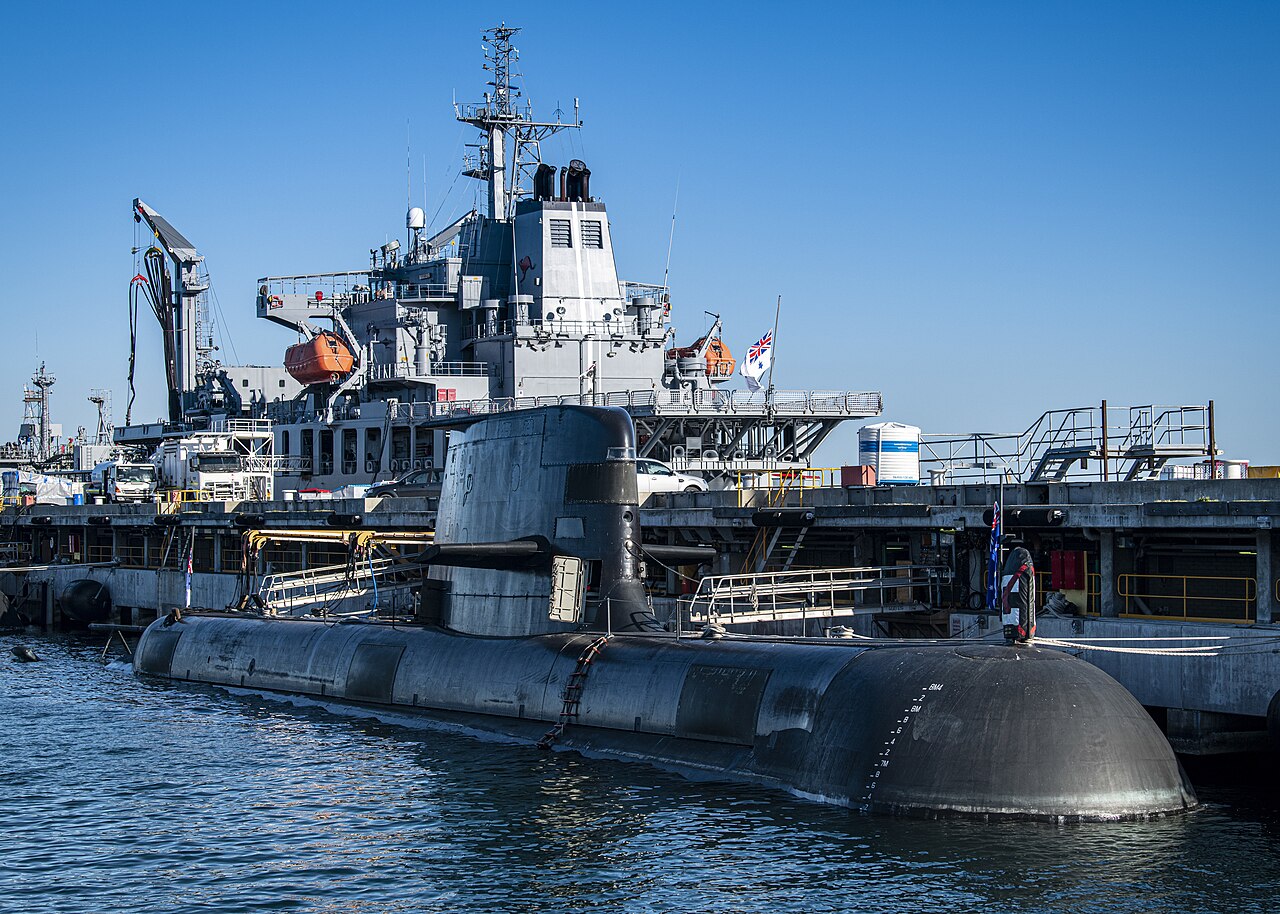
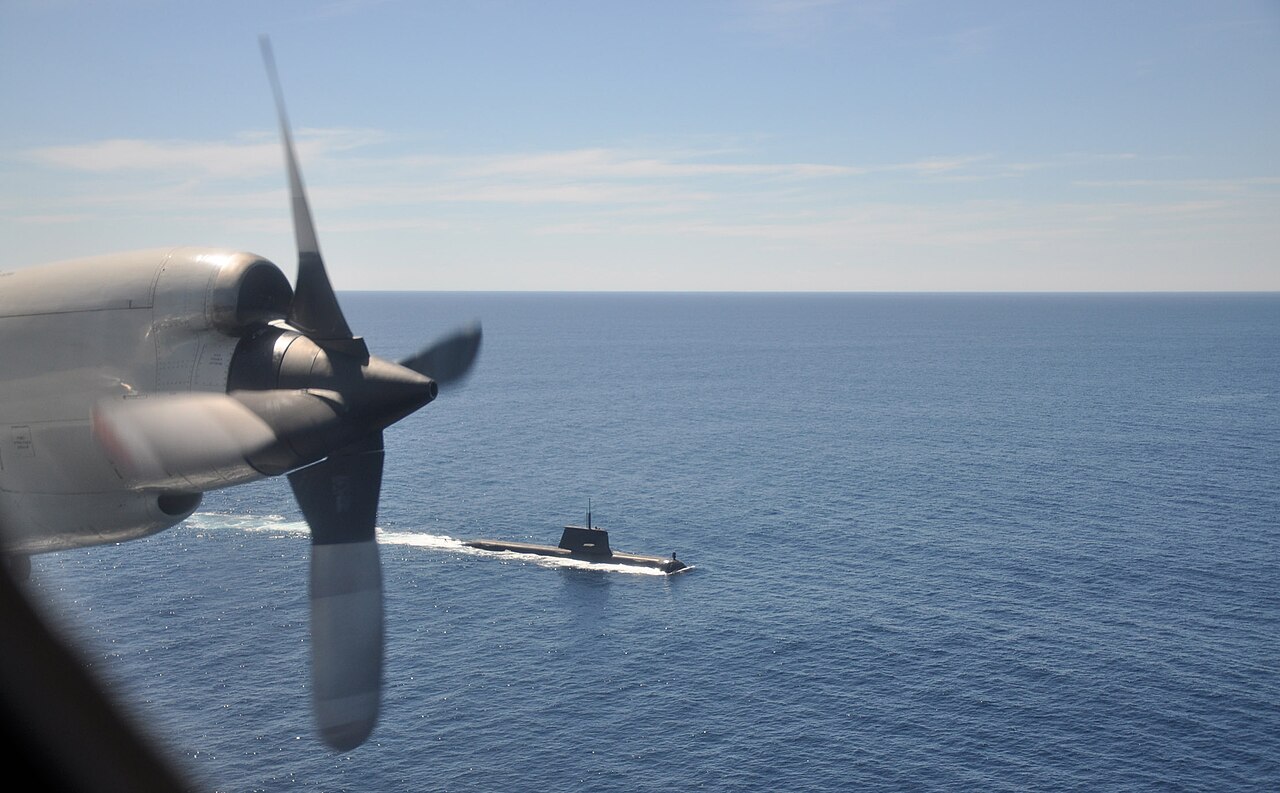
The Royal Australian Navy, by comparison, fields six ageing Collins-class submarines of which only one was fully operational in late 2024, three Hobart-class destroyers, and eight Anzac-class frigates. It has no aircraft carriers, no nuclear submarines, and no prospect of receiving its first Virginia-class boat under AUKUS until approximately 2032. The numerical ratio between the two navies is not a gap that can be closed by clever tactics, alliance commitments, or incremental budget increases. It is a structural imbalance of a kind that would take decades to address even under the most optimistic assumptions.
The missile forces have undergone an equally dramatic transformation, and their strategic significance is arguably greater than the naval expansion because they are designed to negate the single most important military advantage the United States has held in the western Pacific since 1945: the aircraft carrier. The DF-21D, with a range exceeding 1,500 kilometres and a manoeuvrable re-entry vehicle, was the world's first weapon specifically designed to destroy carriers at long range. The DF-26, with a range of over 5,000 kilometres, can reach American bases across the western Pacific including Guam, with approximately 250 to 400 launchers deployed across at least seven brigades. The DF-41 intercontinental ballistic missile can strike any target on earth, carrying three to ten independently targetable warheads. In hypersonic weapons, the Pentagon has concluded that China possesses the world's leading arsenal, with the DF-17 glide vehicle operating at Mach 5 to 10, the DF-27 making China the first nation to field an operational conventionally armed intercontinental ballistic missile, and the YJ-21 providing hypersonic anti-ship capability from both aircraft and surface ships. At the September 2025 Victory Day parade in Beijing, the most comprehensive public display of Chinese military power ever staged, China unveiled an array of new systems including the DF-61 road-mobile ICBM, the JL-3 submarine-launched ICBM, and the JL-1 air-launched ballistic missile, publicly completing its nuclear triad for the first time.

The nuclear expansion behind these delivery systems is the most rapid in history. China possessed approximately 200 warheads in the late 2010s, a number that had remained relatively stable for decades. By mid-2024, the Pentagon estimated 600, a tripling in roughly four years. Projections point to over 1,000 by 2030 and 1,500 by 2035. Three massive ICBM silo fields have been constructed at Yumen, Hami, and Yulin, totalling roughly 320 new solid-fuel silos. Total ICBM launchers now number over 460. The Pentagon has confirmed that China is making progress toward a launch-on-warning nuclear posture, a shift from minimum deterrence toward a stance in which missiles could be launched on the basis of early warning data rather than confirmed attack, dramatically increasing the risk of nuclear escalation during a crisis. Australia possesses zero nuclear weapons and relies entirely on the credibility of American extended deterrence, a credibility that erodes with every warhead China adds and every silo it fills.
In the air, China has produced over 300 J-20 stealth fighters at a rate that outpaces American fifth-generation acquisition by a factor of three. The J-20 exists in three variants, including a twin-seat model designed for manned-unmanned teaming and drone swarm coordination, the world's first two-seat fifth-generation fighter. Two sixth-generation prototypes were spotted at test facilities in late 2024, potentially reaching service before America's own next-generation fighter. The PLA Air Force fields approximately 3,100 combat aircraft in total, outnumbering Australia's combined fleet of F-35As, Super Hornets, and Growlers by approximately eighteen to one. In space, China tested a kinetic anti-satellite weapon in 2007 and has since deployed multiple systems capable of reaching geosynchronous orbit. In cyberspace, the Volt Typhoon campaign embedded itself in American critical infrastructure with the assessed intent of disrupting military operations during a future conflict, while the Salt Typhoon campaign breached the networks of major US telecommunications providers. In April 2024, the PLA dissolved its Strategic Support Force and created three independent arms reporting directly to the Central Military Commission, the Aerospace Force, the Cyberspace Force, and the Information Support Force, reflecting how centrally Beijing has placed these domains in its planning for the next war.
Every one of these capabilities was developed within the professional lifetime of a single generation of military planners. An officer who watched Desert Storm as a young lieutenant in 1991 and concluded that his country could not fight a modern war would now, thirty-five years later, command forces equipped with stealth fighters, hypersonic missiles, electromagnetic-catapult aircraft carriers, a rapidly expanding nuclear arsenal, and the industrial base to sustain and replace all of it at a pace no Western nation can match. The transformation is not complete, the PLA has not fought a war since 1979 and its capacity for joint operations under fire remains untested, but the trajectory is unmistakable, and the question it poses to Australia and every other nation in the Indo-Pacific is no longer whether China can project power across the western Pacific but whether anyone can stop it.
The factory floor
The arsenal described above is formidable on its own terms, but it is not the most strategically significant thing about China's military buildup. The most significant thing is the industrial base that produced it, because that base determines not just what China has today but what it can produce tomorrow, next year, and for as long as a conflict lasts.
China accounts for twenty-eight per cent of global manufacturing output, approximately 4.7 trillion dollars in value added, more than the United States, Japan, and Germany combined. It has held the position of the world's largest manufacturer for fifteen consecutive years, and a United Nations Industrial Development Organisation study projects it will account for forty-five per cent of global industrial production by 2030, while the collective share of Western nations drops to eleven per cent. In the early 2000s, high-income countries still controlled roughly seventy-five per cent of global industrial output. That era is ending, and the military implications of its passing are profound.

The shipbuilding comparison captures the asymmetry in its starkest form. Chinese shipyards possess 232 times the tonnage capacity of American yards. That is not a misprint. A single Chinese shipyard, Jiangnan on Changxing Island in Shanghai, is estimated to have greater capacity than all American shipyards combined. The same drydock that built the Fujian aircraft carrier previously held a commercial container ship, and satellite imagery has shown an Evergreen container vessel moored at a pier alongside two Type 055 cruisers and a Type 052D destroyer, the civilian and military production literally side by side. In 2024, China built over a thousand commercial vessels. The United States built eight. The state shipbuilding conglomerate CSSC built more commercial tonnage in that single year than the entire American shipbuilding industry has produced since the end of the Second World War.
In 2024, China built over a thousand commercial vessels. The United States built eight.
This is what civil-military fusion looks like in practice. The same factories that produce consumer electronics produce military guidance systems. The same shipyards that build container ships build destroyers. The same steel mills that supply construction projects supply armour plate. The same research universities that publish in international journals conduct classified weapons research. The boundary between civilian and military production, which Western nations maintain as a matter of legal, regulatory, and cultural principle, does not exist in China as a matter of deliberate policy. The consequence is that China's military production capacity is not the output of a dedicated defence sector, as it is in Australia or the United States. It is the output of the largest industrial economy in human history, directed by a state that can redirect any fraction of it toward military purposes at any time without needing to seek parliamentary approval, satisfy environmental review, negotiate with unions, or survive a change of government.
The cost advantages that flow from this arrangement are structural and likely permanent. China produces over half the world's steel, more than a billion tonnes annually against America's eighty million. It controls roughly seventy per cent of global rare earth mining, ninety-one per cent of rare earth separation and refining, and ninety-nine per cent of heavy rare earth processing. Labour costs in Chinese defence manufacturing run at a fraction of Western equivalents, a reality that purchasing power parity adjustments only begin to capture. When the RAND Corporation assessed Australian naval shipbuilding costs, it found them thirty to forty per cent higher than American benchmarks, which are themselves vastly higher than Chinese costs. Australia is paying approximately nine billion dollars per Hunter-class frigate for a platform that carries fewer weapons than a Chinese Type 055 cruiser-destroyer built at a fraction of the price on a hull assembled in months rather than years.
What this means in a sustained conflict is straightforward and alarming. The side that can produce more ships, more missiles, more drones, more ammunition, and more replacement parts, and produce them faster and cheaper than the other side, holds a structural advantage that no amount of tactical brilliance or technological sophistication can overcome. The lesson of Ukraine's fifth year of war, discussed in the previous part of this series, is that industrial depth determines endurance and endurance determines outcomes. China's industrial depth, relative to any plausible combination of adversaries in the Indo-Pacific, does not merely represent a quantitative advantage. It exists on a different scale entirely. China conducted more than 135 ballistic missile live firings in 2021, more than the rest of the world combined outside active conflict zones. More than sixty per cent of its missile-related facilities have shown signs of expansion since 2020. If a conflict over Taiwan consumed five thousand American long-range missiles in three weeks, as the Center for Strategic and International Studies has estimated, China's production capacity to replace its own losses would far exceed anything the United States or its allies could match.
The stealth fighter production rate illustrates the point with particular clarity. China produces J-20s at 100 to 120 per year. Australia's entire operational fleet of seventy-two F-35As, delivered over more than a decade, represents less than one year of Chinese fifth-generation fighter production. If losses were sustained in a conflict, China could replace its entire stealth fighter force within three years. Australia could not replace a single squadron within a decade. The same arithmetic applies to every category of military hardware. China is not merely building a larger military. It is building a military backed by an industrial machine that can sustain, replace, and expand its forces under conditions that would exhaust any Western competitor.
Two clocks
Everything described here exists within a timeframe, and understanding that timeframe is essential to understanding why this series argues for the urgency it does.
China's population peaked in 2021 or 2022 at approximately 1.426 billion and is now declining at an accelerating rate. Just 7.92 million births were recorded in 2025 against 11.31 million deaths, a net loss of 3.39 million people in a single year. The total fertility rate has collapsed to approximately 1.09, half the replacement level and among the lowest on earth. Pro-natalist policies have had negligible effect; in February 2026, the Cyberspace Administration resorted to censoring online content that spread what it called fear of marriage. The working-age population peaked around 2011 to 2015 and faces a projected twenty-eight per cent contraction by 2050. By that year, roughly forty per cent of the population will be over sixty and only ten per cent under fifteen. Maintaining a two-million-strong military becomes progressively more difficult as the same shrinking cohort of young people must simultaneously staff factories, care for the elderly, sustain economic output, and fill the ranks.
This demographic reality does not reduce the military threat. It amplifies it, because it creates a closing window of opportunity that Beijing's leadership understands with precision. If China intends to use force to resolve the Taiwan question, to consolidate control over the South China Sea, or to establish the regional primacy that its stated strategic objectives demand, the optimal period for doing so is before 2035 to 2040, while the demographic, economic, and military conditions remain favourable. After that window closes, China will be an ageing society with a shrinking workforce, growing pension and healthcare obligations, and diminishing capacity to sustain the kind of military buildup this essay has described. Xi Jinping, born in 1953 and now seventy-two, has staked his personal legacy on national rejuvenation. CIA Director William Burns stated in February 2023 that Xi had instructed the PLA to be ready for a Taiwan operation by 2027. Admiral Philip Davidson, then commander of US Indo-Pacific Command, told the Senate Armed Services Committee in March 2021 that the threat would manifest within six years. The 2027 PLA centennial, the 2035 modernisation target, and the 2049 centenary of the People's Republic are not abstract aspirations. They are deadlines set by a leader who has consolidated more personal power than any Chinese ruler since Mao and who is running out of time to use it.
But China's demographic window is only half the story, and it is the less alarming half. The other clock is ticking in the West, and it is ticking in the wrong direction.
The same period that has seen China's industrial base expand to twenty-eight per cent of global manufacturing and counting has seen the West's industrial capacity hollow out to a degree that would have been unthinkable a generation ago. In the early 2000s, high-income countries controlled roughly seventy-five per cent of global industrial output. By 2030, that share is projected to fall to eleven per cent. The United States, which built the arsenal of democracy that won the Second World War and produced the technological overmatch that destroyed Iraq's military in 1991, now builds eight ships a year while China builds a thousand. Its shipyards possess less than half of one per cent of Chinese capacity. Its artillery shell production had fallen so low by the mid-2010s that rebuilding it to meet the demands of a single allied war in Ukraine has taken years and remains incomplete. Europe's condition is worse: NATO allies have discovered they cannot sustain modest contributions to a land war in their own continent without running out of ammunition, and their defence industrial base has atrophied to the point where surge production is measured in years rather than months. Australia's industrial base, as later parts of this series will document in detail, has been deliberately hollowed out over three decades of offshoring, outsourcing, and complacent reliance on imported manufactures.
The convergence of these two trends, China's military and industrial rise on one side and the West's manufacturing decline on the other, creates a strategic dynamic far more dangerous than either trend alone. There is a point, not distant and not theoretical, at which China's capacity to project power and sustain a conflict will so far exceed the combined capacity of the Western nations and their Indo-Pacific allies to resist it that the balance becomes functionally unrecoverable. That point is not 2050. Based on current trajectories, it could arrive in the mid-2030s, which is precisely when China's own demographic window begins to close. The two clocks are synchronised: China's last best chance to act coincides with the West's weakest point, and both are approaching within the next ten to fifteen years.
The two clocks are synchronised: China's last best chance to act coincides with the West's weakest point.
Australia's own capability gap sits squarely within this convergence. The Collins-class submarines provide negligible deterrence. The first Virginia-class boat will not arrive until 2032. The first SSN-AUKUS will not be delivered until the early 2040s. The Hunter-class frigates begin delivery from 2032 at the earliest, assuming no further delays. Defence spending sits at 2.3 per cent of GDP against a strategic environment that Australia's own government has described as the most challenging since the Second World War. The gap between what Australia is spending and what the strategic environment demands is not a matter of cautious disagreement among experts. It is a measurable failure to match policy to reality, and the window in which that failure can be corrected is closing from both directions simultaneously.
The 2023 Defence Strategic Review stated that China's military buildup is occurring without transparency or reassurance, and concluded that Australia may have already entered a decisive period for the Indo-Pacific. The evidence assembled in this essay supports that conclusion and sharpens it. China has executed the most consequential military transformation in modern history, from a peasant army that could not contest two American aircraft carriers in 1996 to the world's largest navy and leading hypersonic arsenal in 2026, backed by an industrial base that can outproduce any adversary indefinitely. It has done so within a demographic window that will not remain open, and the West's capacity to respond is diminishing at the same time.
The question that follows is not whether this buildup is real. It is what China intends to do with it, what it is already doing with it, and what it has already done.
Next in the series: what China intends to do with this power, and what it is already doing with it.