Four projects backed by 2023 NSW firming tender achieve 3 GWh milestone
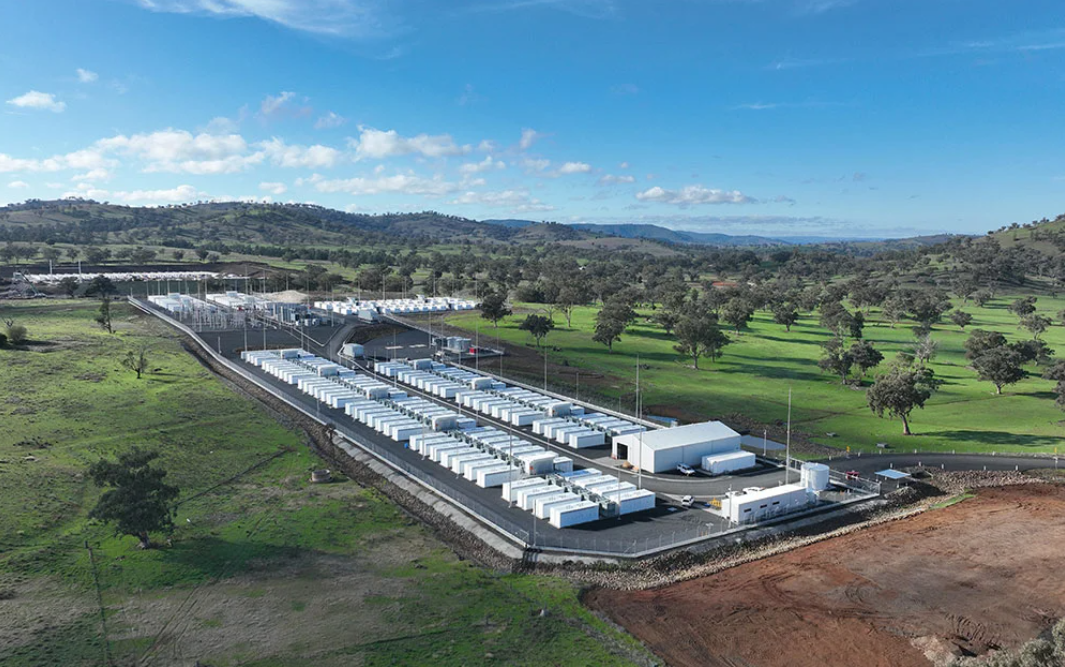
Four battery storage projects built under NSW's 2023 firming tender have now reached operational status, delivering 1 GW of instantaneous capacity and 3 GWh of stored energy. The projects are Iberdrola's 65 MW / 130 MWh Smithfield battery near Sydney, Akaysha Energy's 415 MW / 1.6 GWh Orana battery in the Central-West, AGL's 500 MW / 1 GWh Liddell battery at the former coal station near Newcastle, and Enel X's distributed virtual power plants across the east coast. Together they represent about 8% of NSW summer peak demand and were funded through Long-Term Energy Service Agreements under the Electricity Infrastructure Roadmap. The tender was initially set to procure 380 MW but expanded to 930 MW, with federal support adding a further 55 MW through the Capacity Investment Scheme.
Where this fits
This is a partial answer to grid reliability as coal generation retires. It addresses one of the three core costs of a renewables-led grid: the need for firming. What it does not yet resolve is the material dependency embedded in that firming. All lithium-ion battery packs are manufactured offshore, predominantly in China's coal-powered supply chain, and all are designed for 10 to 15 year lives before landfill or recycling. The article does not disclose the origin or cost of these batteries or quantify the embedded emissions in their production.
What it means
NSW has now contracted about 30 GWh of long-duration storage capacity under the firming tender. That is firming for a few hours at peak. A firm, dispatchable, low-material, long-lived alternative, nuclear, remains banned by federal law. Australia continues to build a weather-dependent grid firmed by Chinese-supplied batteries and backed by gas, rather than develop the only proven low-carbon generation source that requires neither foreign minerals nor ongoing combustion.
By the numbers
at ~A$600–1000/kWh installed. Source: BNEF, CSIRO GenCost 2024-25. Indicative.
of average national (NEM) demand if fully dischargeable, then it needs recharging. Storage shifts power, it does not generate it.
lithium, graphite, nickel, copper and cobalt (~300 t lithium content). Replaced roughly every 12 years. Source: IEA, Argonne GREET. Indicative.
~75% of cells are China-made. Source: IEA cell-manufacturing share.
enough for 1–3 TWh a year of firm, always-on power, generating for ~60 years. Source: CSIRO GenCost 2024-25 (A$8.5–13.2bn/GW), IAEA capacity factor.
Figures are indicative conversions from the article's stated quantity using published cost, material and capacity factors (CSIRO GenCost, BNEF, IEA, IAEA). Ranges, not precise forecasts.
Go deeper on the numbers
The bigger picture
Energy security is national security. This connects to the wider case at Unprepared: Australia's dependence on a strategic rival, and how ready it is for the world that is coming.
Reported by PV Magazine Australia. Read the original report ↗
Related coverage
Victoria backs away from renewable transmission projects - MacroBusiness
Big battery for big super: Aware to help keep Victoria’s lights on - AFR
“Bowen test:” Giant data centre plan will challenge federal resolve on renewables
Can renewables handle the data centre boom? - ABC News & Headlines – Australian Broadcasting Corporation
The numbers, as they move
A short, sourced brief when the figures shift: a transmission blow-out, a supply-chain move, a milestone.