Waratah Super Battery reaches full commercial operations
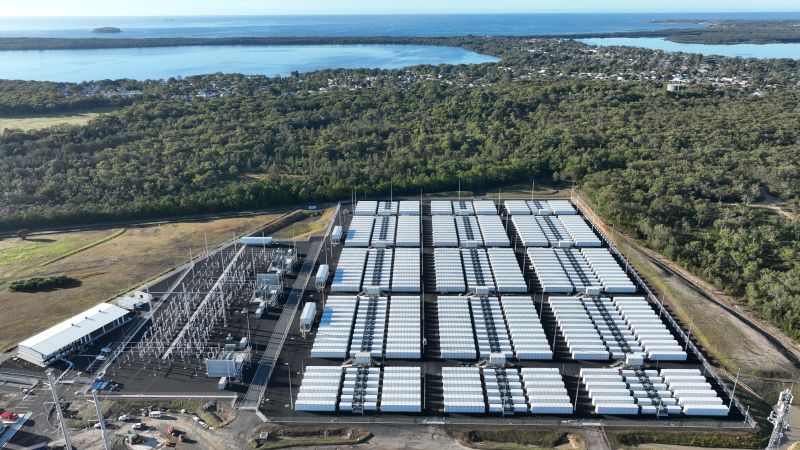
NSW's Waratah Super Battery, a 850 MW / 1,680 MWh system built on the site of the retired Munmorah coal plant, has reached full commercial operation. The facility cost more than USD 700 million. It is designed to act as a grid stabiliser, absorbing short-term frequency and voltage swings as coal plants retire and renewable energy penetration increases. A complementary 700 MW control system built by Transgrid will detect and respond to transmission faults in real time. The battery can supply peak power to roughly 340,000 NSW homes.
Where this fits
Waratah demonstrates the hidden cost of a renewables-only transition. The battery alone is not firm power: it holds 1,680 MWh of energy, which at 850 MW output lasts less than two hours at full discharge. Its real role is shock absorption and frequency support during gaps between wind and solar. The project illustrates two pressures on whole-system cost. First, the battery's USD 700 million price tag is paid to firm a renewable fleet that would otherwise require gas plants to cover multi-hour and multi-day shortfalls. Second, the minerals, manufacturing and supply chain for lithium-ion batteries remain concentrated in China, embedding the grid's resilience into dependence on a strategic rival.
What it means
Waratah plugs a gap in NSW's short-term stability, but cannot replace the firm, all-weather output that coal once delivered. As more coal retires, Australia will require either vast battery fleets (capital-intensive, weather-dependent in end-of-life, China-reliant) or gas (emissions, fuel-price exposure). The alternative, firm, low-material, low-emission nuclear generation, remains legally banned in Australia, leaving the transition path locked into high cost and Chinese supply-chain dependence.
By the numbers
at ~A$600–1000/kWh installed. Source: BNEF, CSIRO GenCost 2024-25. Indicative.
of average national (NEM) demand if fully dischargeable, then it needs recharging. Storage shifts power, it does not generate it.
lithium, graphite, nickel, copper and cobalt (~168 t lithium content). Replaced roughly every 12 years. Source: IEA, Argonne GREET. Indicative.
~75% of cells are China-made. Source: IEA cell-manufacturing share.
enough for 1–2 TWh a year of firm, always-on power, generating for ~60 years. Source: CSIRO GenCost 2024-25 (A$8.5–13.2bn/GW), IAEA capacity factor.
Figures are indicative conversions from the article's stated quantity using published cost, material and capacity factors (CSIRO GenCost, BNEF, IEA, IAEA). Ranges, not precise forecasts.
enough for 1–1 TWh a year of firm, always-on power, generating for ~60 years. Source: CSIRO GenCost 2024-25 (A$8.5–13.2bn/GW), IAEA capacity factor.
Figures are indicative conversions from the article's stated quantity using published cost, material and capacity factors (CSIRO GenCost, BNEF, IEA, IAEA). Ranges, not precise forecasts.
Go deeper on the numbers
The bigger picture
Energy security is national security. This connects to the wider case at Unprepared: Australia's dependence on a strategic rival, and how ready it is for the world that is coming.
Reported by PV Magazine Australia. Read the original report ↗
Related coverage
More batteries, both big and small, mean solar farms don’t have to shut down so often - Renew Economy
Concrete foundations completed for all 18 turbines at first and smallest wind farm to begin construction this year
Australia’s gas generation falls to lowest level since 2000 — OilPrice - UA.NEWS
Renewables Boom Pushes Australia's Gas Power to Quarter-Century Low - Crude Oil Prices Today | OilPrice.com
The numbers, as they move
A short, sourced brief when the figures shift: a transmission blow-out, a supply-chain move, a milestone.