What Victoria’s Cancelled Renewable Zone Means for Business Energy Planning
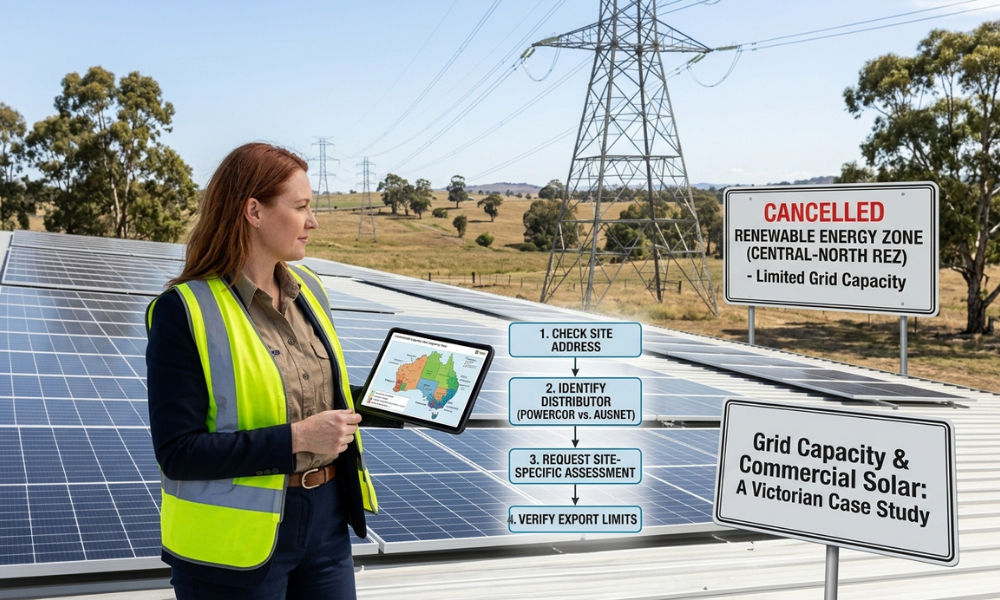
Victoria has cancelled a renewable energy zone due to insufficient grid capacity to accommodate the planned generation, creating uncertainty for commercial solar projects in the affected region and signalling broader constraints on renewable deployment.
Where this fits
This is a live example of the transmission and firming cost hidden in the renewables-only pathway. The cancellation reveals that renewable capacity cannot simply be added at will. Grid infrastructure, particularly transmission, is the binding constraint. A large renewable build requires either massive overbuild of transmission lines (a cost rarely front-loaded in project economics) or acceptance that generation will be curtailed when the network cannot carry it. This is a reliability and cost problem. A firm dispatchable source like nuclear, constrained only by fuel supply and operating licence rather than by network topology, avoids the same bottleneck.
What it means
Commercial operators relying on the cancelled zone now face delayed projects and higher grid-connection costs elsewhere. At the system level, this signals that Australia's renewable rollout is bumping against infrastructure limits faster than transmission planning can address. Each cancelled or delayed zone pushes more generation toward already-congested networks, raising both curtailment risk and the cost of the transmission overbuild needed to firm a weather-dependent grid. The pattern is clear: renewables are cheap per megawatt-hour, but connecting them reliably and affordably to the network adds material cost and complexity. A firm nuclear plant, by contrast, needs one transmission line and no weather hedging. The cancelled zone is not a problem with renewable technology itself, it is a problem with the speed and cost of building the whole system around it.
Go deeper on the numbers
The bigger picture
Energy security is national security. This connects to the wider case at Unprepared: Australia's dependence on a strategic rival, and how ready it is for the world that is coming.
Reported by Energy Matters. Read the original report ↗
Related coverage
More batteries, both big and small, mean solar farms don’t have to shut down so often - Renew Economy
Concrete foundations completed for all 18 turbines at first and smallest wind farm to begin construction this year
Australia’s gas generation falls to lowest level since 2000 — OilPrice - UA.NEWS
Renewables Boom Pushes Australia's Gas Power to Quarter-Century Low - Crude Oil Prices Today | OilPrice.com
The numbers, as they move
A short, sourced brief when the figures shift: a transmission blow-out, a supply-chain move, a milestone.