Horizon advances solar and battery solution to power remote WA town
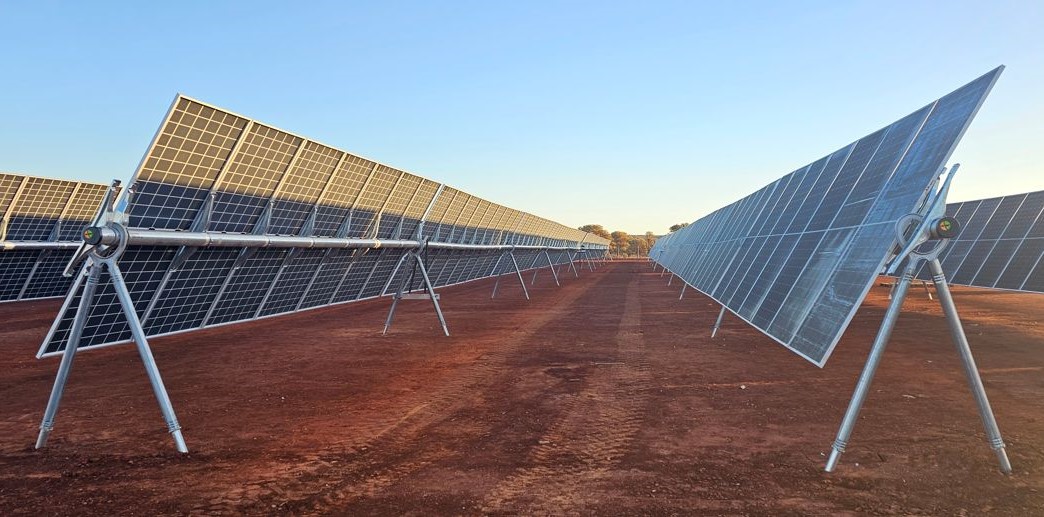
Horizon Power has completed installation of 3,780 solar panels at a 2.4 MW solar farm near Leonora in Western Australia's Goldfields region. The system combines solar generation with a 9.9 MWh battery and 2.7 MW of diesel generation to form a hybrid microgrid. The project is designed to meet about 60% of Leonora's energy demand from solar and stored battery power, with diesel providing the firm backup. First power is expected in 2027 under a 20-year power purchase agreement with Pacific Energy. Horizon Power operates more than 35 microgrids across regional Western Australia, most still relying on gas or diesel as primary generation.
Where this fits
This project exemplifies the renewable-plus-battery model now standard in remote and regional Australia, but it reveals the ceiling on what that model can deliver. Leonora cannot run on solar and battery alone: even with a 2.4 MW solar farm and 9.9 MWh of storage, diesel must provide firm capacity and fill the gaps when sun and stored energy run out. The 60% renewable target is not ambition; it is the limit of what the technology can reliably supply. Every megawatt-hour the battery cannot store must come from diesel, and every kilowatt of firming capacity must be built and maintained in addition to the renewables.
What it means
Australia's regional grids are being engineered toward a permanent hybrid state: renewable generation plus battery storage plus diesel backup. This architecture works for towns, but it locks in long-term dependence on fuel imports and avoids the harder question of why firm, energy-dense alternatives like nuclear remain off the table. The real cost of the Leonora system is not the solar panels or battery pack; it is the perpetual diesel generation, the supply chain exposure, and the forgone option of genuinely dispatchable Australian power.
By the numbers
at ~A$1100–1600/kW installed. Source: CSIRO GenCost 2024-25. Indicative.
at a ~24% capacity factor, and only when the sun shines, so it still needs firming.
~80% of modules are China-made. Source: IEA solar supply-chain data.
enough for 2–4 TWh a year of firm, always-on power, generating for ~60 years. Source: CSIRO GenCost 2024-25 (A$8.5–13.2bn/GW), IAEA capacity factor.
Figures are indicative conversions from the article's stated quantity using published cost, material and capacity factors (CSIRO GenCost, BNEF, IEA, IAEA). Ranges, not precise forecasts.
Go deeper on the numbers
The bigger picture
Energy security is national security. This connects to the wider case at Unprepared: Australia's dependence on a strategic rival, and how ready it is for the world that is coming.
Reported by PV Magazine Australia. Read the original report ↗
Related coverage
More batteries, both big and small, mean solar farms don’t have to shut down so often - Renew Economy
Concrete foundations completed for all 18 turbines at first and smallest wind farm to begin construction this year
Australia’s gas generation falls to lowest level since 2000 — OilPrice - UA.NEWS
Renewables Boom Pushes Australia's Gas Power to Quarter-Century Low - Crude Oil Prices Today | OilPrice.com
The numbers, as they move
A short, sourced brief when the figures shift: a transmission blow-out, a supply-chain move, a milestone.