Rooftop solar, home battery installs hit record highs
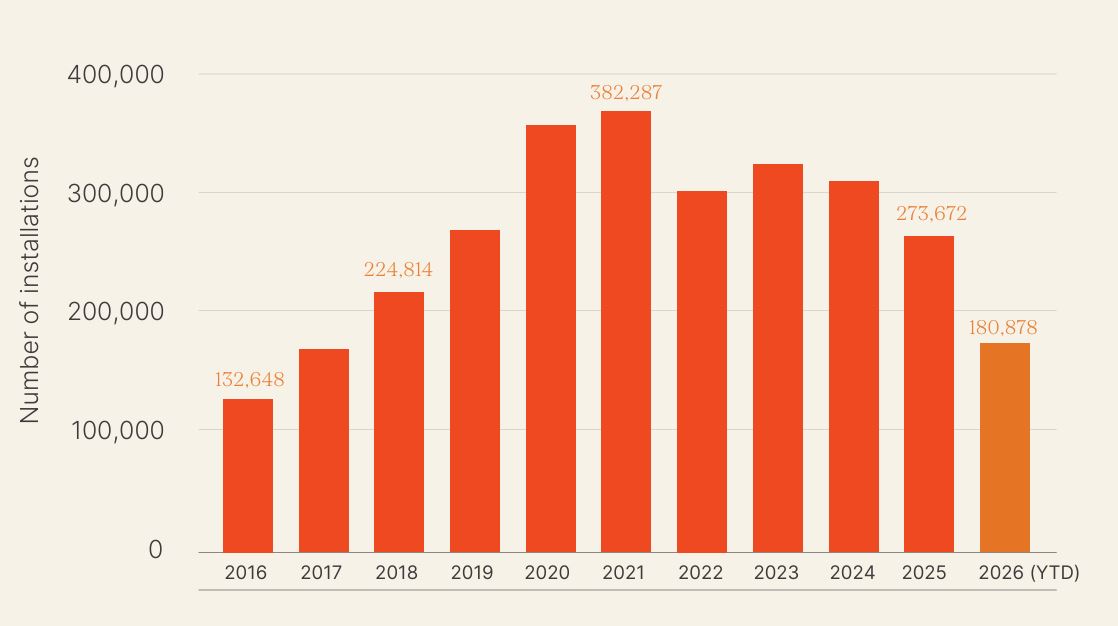
Australia installed 1,894 MW of rooftop solar and 8,691 MWh of home battery storage in the first half of 2026. The Clean Energy Council reports 180,878 solar systems were added in that period, a 35% increase on the same half of 2025. Battery deployments accelerated sharply, with 276,011 units installed, 52% higher than the previous six-month period. The federal Cheaper Home Batteries Program appears to have bundled incentives in a way that drives simultaneous solar and battery uptake. Battery additions now outpace solar installations by a ratio of 153 to 100.
Where this fits
This data reveals the scale of the distributed-storage bet Australia is making to firm a weather-dependent grid. Rooftop solar and home batteries are capital costs paid by households; they do not alter the underlying physics of cloud cover or wind doldrums, which still require firm dispatchable backup. The faster battery deployment outpaces solar installation signals rising grid reliance on storage to bridge gaps that storage alone cannot fill on multi-day low-sun, low-wind events. The question is not whether households should add batteries. It is whether the whole-system cost of firming a renewables-only grid via distributed storage, plus transmission overbuild, plus gas plants kept hot for gaps, is the least-cost path to decarbonisation when a firm, low-material alternative, nuclear, remains legally blocked.
What it means
Australia is building a grid that will need substantial unplanned-for gas-plant capacity and transmission infrastructure to handle the mismatch between battery discharge cycles and seasonal drought. That infrastructure cost, and the ongoing gas fuel cost, are not visible in household battery subsidies. China manufactures the majority of these lithium batteries, inverters and panels; Australia controls neither the supply chain nor the refining of critical minerals, and both depend on Beijing's willingness to export. A firm grid architecture built on domestic nuclear would reduce long-term gas exposure, halve material throughput, and recover energy-policy sovereignty.
By the numbers
at ~A$1100–1600/kW installed. Source: CSIRO GenCost 2024-25. Indicative.
at a ~24% capacity factor, and only when the sun shines, so it still needs firming.
~80% of modules are China-made. Source: IEA solar supply-chain data.
enough for 1–3 TWh a year of firm, always-on power, generating for ~60 years. Source: CSIRO GenCost 2024-25 (A$8.5–13.2bn/GW), IAEA capacity factor.
Figures are indicative conversions from the article's stated quantity using published cost, material and capacity factors (CSIRO GenCost, BNEF, IEA, IAEA). Ranges, not precise forecasts.
at ~A$600–1000/kWh installed. Source: BNEF, CSIRO GenCost 2024-25. Indicative.
of average national (NEM) demand if fully dischargeable, then it needs recharging. Storage shifts power, it does not generate it.
lithium, graphite, nickel, copper and cobalt (~869 t lithium content). Replaced roughly every 12 years. Source: IEA, Argonne GREET. Indicative.
~75% of cells are China-made. Source: IEA cell-manufacturing share.
enough for 3–8 TWh a year of firm, always-on power, generating for ~60 years. Source: CSIRO GenCost 2024-25 (A$8.5–13.2bn/GW), IAEA capacity factor.
Figures are indicative conversions from the article's stated quantity using published cost, material and capacity factors (CSIRO GenCost, BNEF, IEA, IAEA). Ranges, not precise forecasts.
Go deeper on the numbers
The bigger picture
Energy security is national security. This connects to the wider case at Unprepared: Australia's dependence on a strategic rival, and how ready it is for the world that is coming.
Reported by PV Magazine Australia. Read the original report ↗
Related coverage
More batteries, both big and small, mean solar farms don’t have to shut down so often - Renew Economy
Concrete foundations completed for all 18 turbines at first and smallest wind farm to begin construction this year
Australia’s gas generation falls to lowest level since 2000 — OilPrice - UA.NEWS
Renewables Boom Pushes Australia's Gas Power to Quarter-Century Low - Crude Oil Prices Today | OilPrice.com
The numbers, as they move
A short, sourced brief when the figures shift: a transmission blow-out, a supply-chain move, a milestone.