Lava Blue hosts Australia’s first grid-connected sodium-sulphur battery
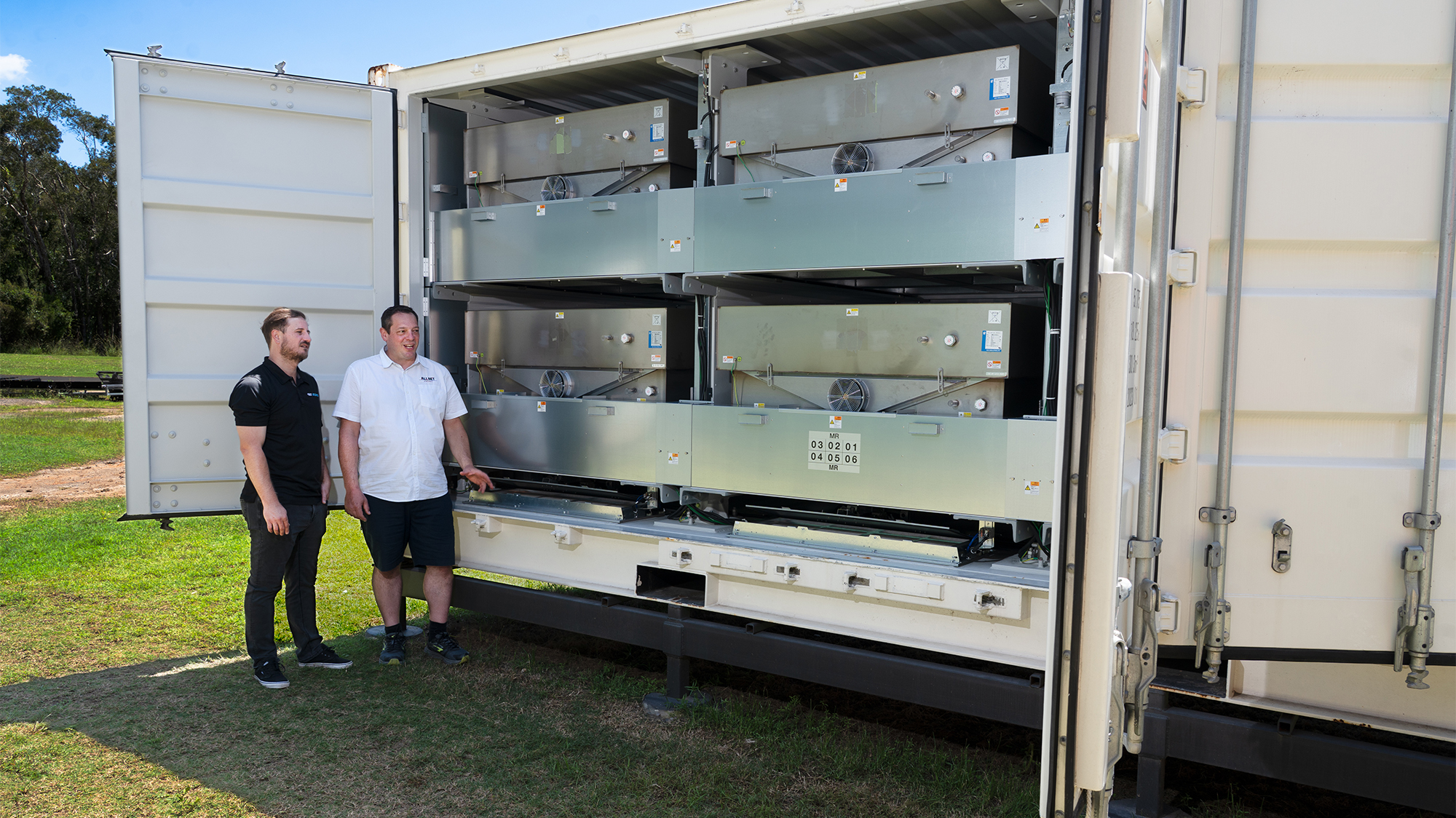
Australia's first grid-connected sodium-sulphur battery has begun operations at a critical minerals processing facility in Brisbane. The 250 kW / 1.45 MWh system, manufactured by Japan's NGK, is paired with 200 kW of solar at the site and connected to the local distribution network. It supplies up to 100 per cent of the facility's peak load during operation, enabling energy-intensive materials processing to run on renewable generation.
Where this fits
Long-duration storage is real, but it is not yet a solution at grid scale. Sodium-sulphur batteries operate at high temperature and are useful for specific industrial loads running 6-8 hours. This is a proof-of-concept in a single facility. Scaling from 1.45 MWh to the terawatt-hour storage Australia needs to firm a renewables-only grid would require vast capital, thousands of tonnes of specialised materials, and manufacturing capacity that does not exist. The technology is also Japan-made, shifting a critical materials and supply-chain dependency from lithium-ion factories in China to NAS producers elsewhere. Until storage reaches grid scale at competitive cost, a renewables-heavy system still relies on gas plants or imported liquefied hydrogen for firming. None of these solve the speed-to-decarbonise problem as well as firm, long-lived nuclear generation.
What it means
This deployment shows that non-lithium storage chemistries can work in real operation, which is valuable for diversifying the battery ecosystem. It does not bridge the gap between laboratory demonstration and economically viable grid-scale firming. Australia remains structurally dependent on either gas backup, massive battery capital expenditure, or both, while firm nuclear generation, lower-cost, lower-emission, and domestically operable, remains prohibited by law.
By the numbers
at ~A$1100–1600/kW installed. Source: CSIRO GenCost 2024-25. Indicative.
at a ~24% capacity factor, and only when the sun shines, so it still needs firming.
~80% of modules are China-made. Source: IEA solar supply-chain data.
Figures are indicative conversions from the article's stated quantity using published cost, material and capacity factors (CSIRO GenCost, BNEF, IEA, IAEA). Ranges, not precise forecasts.
Go deeper on the numbers
The bigger picture
Energy security is national security. This connects to the wider case at Unprepared: Australia's dependence on a strategic rival, and how ready it is for the world that is coming.
Reported by PV Magazine Australia. Read the original report ↗
Related coverage
More batteries, both big and small, mean solar farms don’t have to shut down so often - Renew Economy
Concrete foundations completed for all 18 turbines at first and smallest wind farm to begin construction this year
Australia’s gas generation falls to lowest level since 2000 — OilPrice - UA.NEWS
Renewables Boom Pushes Australia's Gas Power to Quarter-Century Low - Crude Oil Prices Today | OilPrice.com
The numbers, as they move
A short, sourced brief when the figures shift: a transmission blow-out, a supply-chain move, a milestone.