Akaysha secures $1.75 billion finance package to grow battery platform
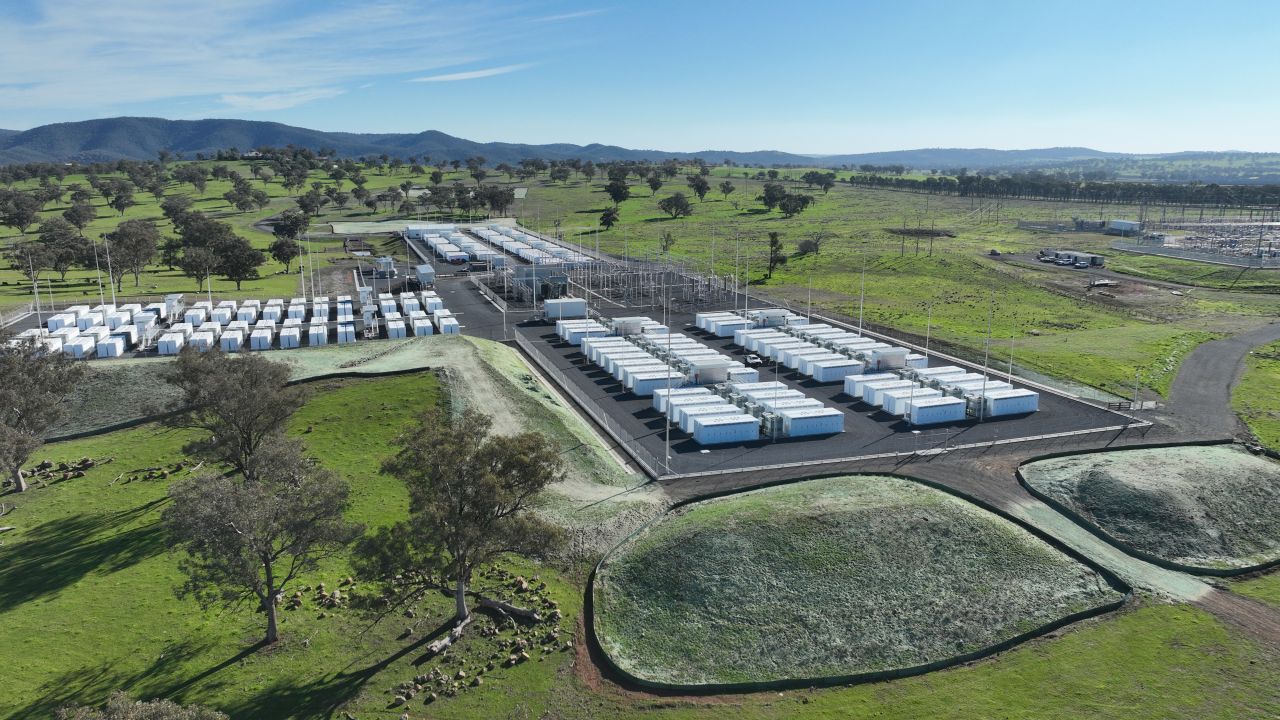
Akaysha Energy, a BlackRock-owned battery developer, has secured $1.75 billion in portfolio-level financing to refinance debt across four operational and under-construction battery projects totalling 1,086 MW / 3,612 MWh, and to accelerate a pipeline of 6 GW / 25 GWh of large-scale battery storage across the National Electricity Market. The refinance consolidates project-level debt from Brendale, Ulinda Park and Orana batteries (all operational) and the Elaine BESS (under construction in Victoria), with plans to deploy capital into pipeline projects including Connewarren (1,000 MW / 4,000 MWh), Glenrowan and Deer Park in Victoria.
Where this fits
Australia is building a renewables-dominant grid that runs on weather. Batteries are essential for smoothing output over hours, but they cannot firm the grid across days of low wind and solar. Every gigawatt-hour of battery deployed is capital that could have built firm, dispatchable generation instead. The $1.75 billion facility signals financial appetite for storage, but 25 GWh of batteries smooths intermittency; it does not solve the seasonal and multi-day gaps that currently gas fills, and will continue to fill, unless nuclear is deployed. This is a reliability and cost story: the capital is real, the firming gap remains.
What it means
Large-scale batteries are now attracting institutional finance, which cuts project risk. That lowers deployment friction. Yet the financing scales a technology that addresses the wrong problem at scale. Batteries cannot replace the firm generation Australia is losing as coal exits. A grid 90 per cent renewable will still need gas turbines spinning on standby or, if firm power is not built, blackout risk will rise. The $1.75 billion is efficient capital deployment for what batteries do. It is not efficient capital deployment for what Australia's grid needs.
By the numbers
enough for 2–2 TWh a year of firm, always-on power, generating for ~60 years. Source: CSIRO GenCost 2024-25 (A$8.5–13.2bn/GW), IAEA capacity factor.
Figures are indicative conversions from the article's stated quantity using published cost, material and capacity factors (CSIRO GenCost, BNEF, IEA, IAEA). Ranges, not precise forecasts.
at ~A$600–1000/kWh installed. Source: BNEF, CSIRO GenCost 2024-25. Indicative.
of average national (NEM) demand if fully dischargeable, then it needs recharging. Storage shifts power, it does not generate it.
lithium, graphite, nickel, copper and cobalt (~2500 t lithium content). Replaced roughly every 12 years. Source: IEA, Argonne GREET. Indicative.
~75% of cells are China-made. Source: IEA cell-manufacturing share.
enough for 9–23 TWh a year of firm, always-on power, generating for ~60 years. Source: CSIRO GenCost 2024-25 (A$8.5–13.2bn/GW), IAEA capacity factor.
Figures are indicative conversions from the article's stated quantity using published cost, material and capacity factors (CSIRO GenCost, BNEF, IEA, IAEA). Ranges, not precise forecasts.
Go deeper on the numbers
The bigger picture
Energy security is national security. This connects to the wider case at Unprepared: Australia's dependence on a strategic rival, and how ready it is for the world that is coming.
Reported by PV Magazine Australia. Read the original report ↗
Related coverage
More batteries, both big and small, mean solar farms don’t have to shut down so often - Renew Economy
Concrete foundations completed for all 18 turbines at first and smallest wind farm to begin construction this year
Australia’s gas generation falls to lowest level since 2000 — OilPrice - UA.NEWS
Renewables Boom Pushes Australia's Gas Power to Quarter-Century Low - Crude Oil Prices Today | OilPrice.com
The numbers, as they move
A short, sourced brief when the figures shift: a transmission blow-out, a supply-chain move, a milestone.