Intera’s 960 MWh Summerfield battery in SA enters commissioning
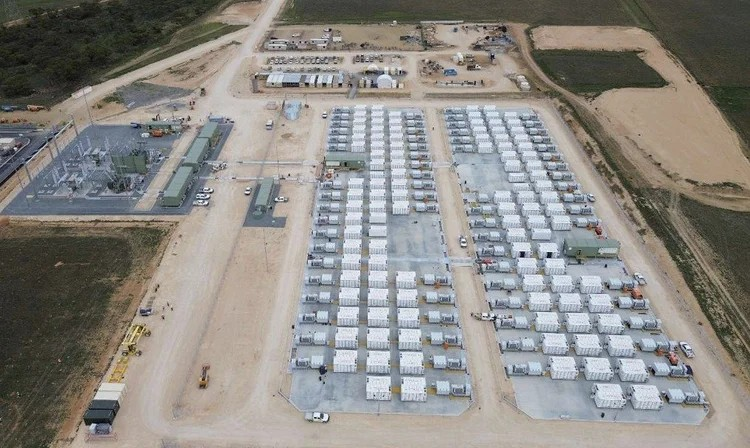
South Australia's Summerfield battery, a 240 MW / 960 MWh system near Mannum, is entering commissioning and due to begin full operations in 2027. The facility, built by Canadian Solar's e-Storage subsidiary for Intera Renewables under a turnkey contract, will store renewable energy during high wind and sun periods and discharge it to the grid when demand peaks. Origin Energy has committed to a 10-year power purchase agreement covering 100% of the output. The project exemplifies the battery-as-firming strategy now central to Australia's path toward high renewable penetration.
Where this fits
Summerfield is a data point on the whole-system cost of a renewables-only grid. A four-hour battery of this scale costs tens of millions to build and install; it stores renewable surplus but cannot substitute for the firm, baseload generation that nuclear provides around the clock. South Australia's renewable share is already high, meaning batteries now spend much of their time idle or cycling at partial capacity. The project also sits on the supply-chain dependency: the battery containers are Canadian Solar's SolBank 3.0 units, and the critical cells, modules, and inverters that make them work flow from China-dominated supply chains. Long-term service agreements, as noted here, lock in further dependence.
What it means
Grid-scale batteries are fast and effective at smoothing short-term mismatches between renewable output and demand. They do not, however, eliminate the need for dispatchable generation or reduce the scale of transmission overbuild required to move renewable energy from high-yield zones to load centers. Australia continues to foreclose the one firm, low-emission alternative, nuclear, by law, while betting its grid resilience and supply-chain sovereignty on batteries built from components sourced from a strategic rival.
By the numbers
at ~A$600–1000/kWh installed. Source: BNEF, CSIRO GenCost 2024-25. Indicative.
of average national (NEM) demand if fully dischargeable, then it needs recharging. Storage shifts power, it does not generate it.
lithium, graphite, nickel, copper and cobalt (~96 t lithium content). Replaced roughly every 12 years. Source: IEA, Argonne GREET. Indicative.
~75% of cells are China-made. Source: IEA cell-manufacturing share.
enough for 0–1 TWh a year of firm, always-on power, generating for ~60 years. Source: CSIRO GenCost 2024-25 (A$8.5–13.2bn/GW), IAEA capacity factor.
Figures are indicative conversions from the article's stated quantity using published cost, material and capacity factors (CSIRO GenCost, BNEF, IEA, IAEA). Ranges, not precise forecasts.
Go deeper on the numbers
The bigger picture
Energy security is national security. This connects to the wider case at Unprepared: Australia's dependence on a strategic rival, and how ready it is for the world that is coming.
Reported by PV Magazine Australia. Read the original report ↗
Related coverage
More batteries, both big and small, mean solar farms don’t have to shut down so often - Renew Economy
Concrete foundations completed for all 18 turbines at first and smallest wind farm to begin construction this year
Australia’s gas generation falls to lowest level since 2000 — OilPrice - UA.NEWS
Renewables Boom Pushes Australia's Gas Power to Quarter-Century Low - Crude Oil Prices Today | OilPrice.com
The numbers, as they move
A short, sourced brief when the figures shift: a transmission blow-out, a supply-chain move, a milestone.