Big solar and battery project gets federal green tick for contested REZ, with conditions
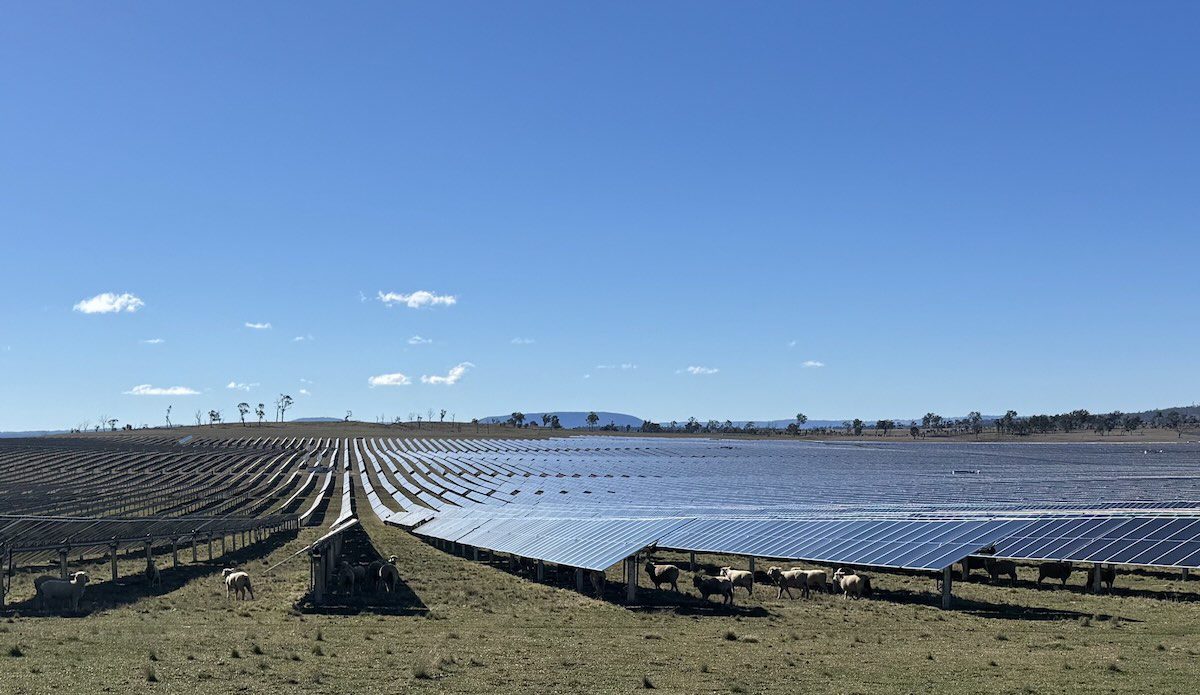
A 350 MW solar and 150 MW, four-hour battery project in NSW's New England renewable energy zone has received federal environmental approval. The Sundown project, developed by Recurrent Energy (Canadian Solar subsidiary), cleared state planning in August and federal EPBC sign-off on 23 October. The approval runs to 2066 and requires biodiversity offsets and an environmental management plan. The project has secured state and federal sign-off but still needs grid connection before construction can begin.
Where this fits
This is a data point in the cost and reliability story. A 150 MW, four-hour battery stores just 600 MWh: enough to bridge a few hours of cloudy weather or evening demand, not a night or a week. In a renewables-only grid, Australia will need vastly more storage, transmission infrastructure to move variable output across regions, and firm dispatchable power, mostly gas, to cover days when solar output is low and batteries are depleted. The New England REZ, like all REZs, is being built on the assumption that weather-dependent generation plus short-duration storage plus gas firming plus a transmission overbuild equals reliability. Each component adds whole-system cost. The materials, panels, inverters, battery cells, processed minerals, are sourced from or refined in China, a strategic rival whose supply chain is both a cost and a sovereignty risk.
What it means
Australia is building its energy system piecemeal, project by project, against a weather-dependent output curve that requires continuous gas backup and ever-larger transmission. A firm alternative, nuclear, with no weather dependency, minimal materials per megawatt, lowest lifecycle emissions, and 60-year operating life, is banned by law. This project is not a problem on its own. It is a brick in a wall that will cost more to maintain, emit more over its lifecycle once China's coal-fired supply chain is counted, and leave Australia dependent on gas imports and Chinese supply chains for the energy transition itself.
By the numbers
at ~A$1100–1600/kW installed. Source: CSIRO GenCost 2024-25. Indicative.
at a ~24% capacity factor, and only when the sun shines, so it still needs firming.
~80% of modules are China-made. Source: IEA solar supply-chain data.
enough for 0–1 TWh a year of firm, always-on power, generating for ~60 years. Source: CSIRO GenCost 2024-25 (A$8.5–13.2bn/GW), IAEA capacity factor.
Figures are indicative conversions from the article's stated quantity using published cost, material and capacity factors (CSIRO GenCost, BNEF, IEA, IAEA). Ranges, not precise forecasts.
at ~A$600–1000/kWh installed. Source: BNEF, CSIRO GenCost 2024-25. Indicative.
of average national (NEM) demand if fully dischargeable, then it needs recharging. Storage shifts power, it does not generate it.
lithium, graphite, nickel, copper and cobalt (~60 t lithium content). Replaced roughly every 12 years. Source: IEA, Argonne GREET. Indicative.
~75% of cells are China-made. Source: IEA cell-manufacturing share.
enough for 0–1 TWh a year of firm, always-on power, generating for ~60 years. Source: CSIRO GenCost 2024-25 (A$8.5–13.2bn/GW), IAEA capacity factor.
Figures are indicative conversions from the article's stated quantity using published cost, material and capacity factors (CSIRO GenCost, BNEF, IEA, IAEA). Ranges, not precise forecasts.
Go deeper on the numbers
The bigger picture
Energy security is national security. This connects to the wider case at Unprepared: Australia's dependence on a strategic rival, and how ready it is for the world that is coming.
Reported by RenewEconomy. Read the original report ↗
Related coverage
The numbers, as they move
A short, sourced brief when the figures shift: a transmission blow-out, a supply-chain move, a milestone.