Nuclear Energy in Australia: Should Homeowners Be Worried About the Debate?
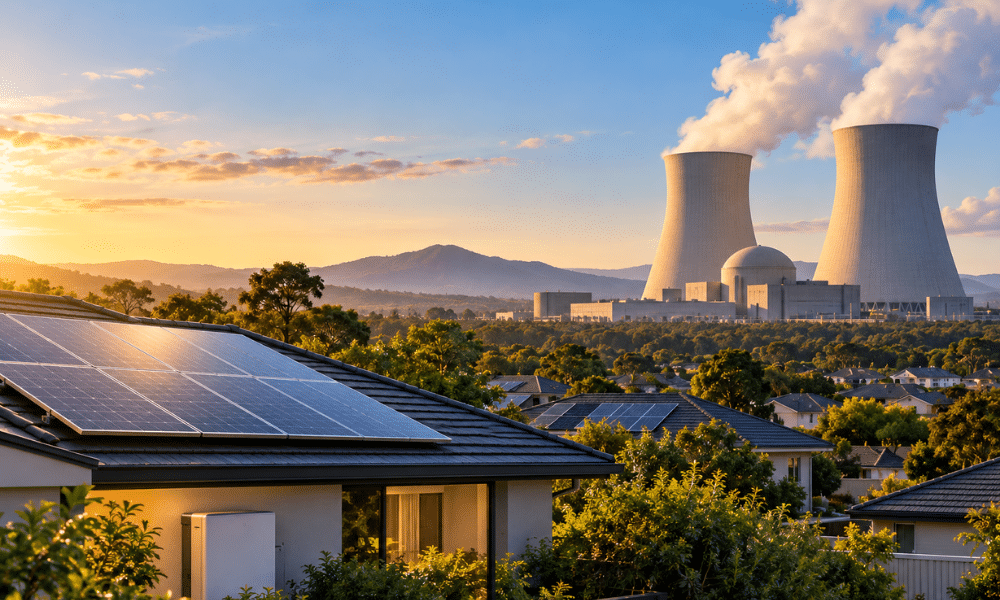
The nuclear debate in Australia has resumed, with discussion centring on cost, timeline and the relationship between nuclear deployment and household solar and battery investment. The article frames the question as a concern for homeowners weighing their own generation choices against a national energy strategy that may or may not include nuclear.
Where this fits
Australia has committed to a renewables-heavy electricity transition without firm dispatchable capacity to back it. The return of nuclear to the policy conversation signals recognition that solar and wind alone cannot reliably serve peak demand or replace gas baseload. This is a materials and cost story disguised as a political story. A renewables-only path requires overbuild of generation (to cover low-output weather days), grid-scale battery capacity (China-dependent, short-lived, energy-intensive to manufacture), and firm gas plants running idle most of the time. Nuclear addresses the firm-power requirement with a single technology. Australia banned nuclear generation in 1998; that ban forecloses the lowest-lifecycle-emission firm option and locks in dependence on imported batteries, inverters and panels.
What it means
The fact that this question is back on the table suggests policymakers recognise that household solar does not solve grid-wide reliability. Homeowners should understand that their rooftop panels are not a substitute for grid firming, and that the national choice between a gas-firmed renewables system and a nuclear system will shape electricity price and reliability for decades. The honest trade is not nuclear versus solar, but gas-plus-renewables versus nuclear as the firm backbone. One locks in ongoing fossil fuel burn and China supply-chain dependence; the other forecloses both, but requires lifting the ban.
Go deeper on the numbers
The bigger picture
Energy security is national security. This connects to the wider case at Unprepared: Australia's dependence on a strategic rival, and how ready it is for the world that is coming.

Xi Jinping and the Purge That Built an Army
The PLA that Xi Jinping inherited in 2012 was modernising, and the one he commands in 2026 is transformed. Part IV of the Unprepared series.
Reported by Energy Matters. Read the original report ↗
Related coverage
Paladin targets 2031 uranium production with $525m raising - Australian Resources & Investment
$3.9b uranium player Paladin looks to raise $525m - AFR
Data centres revive Coalition passion for nuclear power, but this time more expensive and even less realistic - Renew Economy
Russia proposes carbon credits framework for SMRs
The numbers, as they move
A short, sourced brief when the figures shift: a transmission blow-out, a supply-chain move, a milestone.