Togo signs nuclear energy MoU with Rosatom
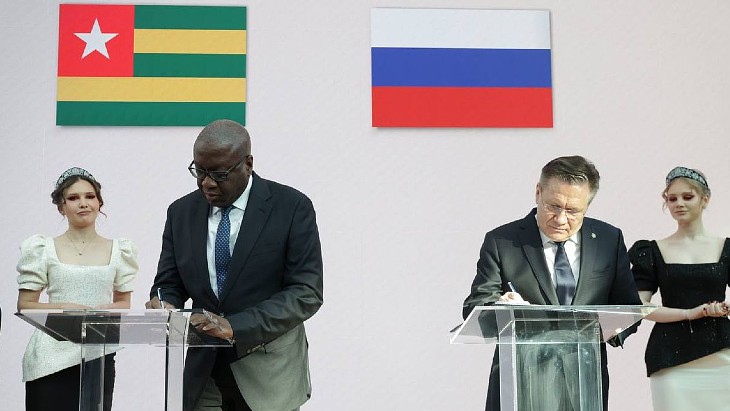
Togo's Ministry of Energy has signed a memorandum of understanding with Russia's state nuclear corporation Rosatom to explore nuclear power deployment, announced at the Russia-Africa Summit in Moscow in October 2026. The agreement covers feasibility assessment, workforce training, public engagement, and potential deployment of floating nuclear units. Rosatom's director general offered support across energy, healthcare and agriculture sectors. Togo's government has signalled nuclear as central to industrialisation and reliable electricity supply, with the Council of Ministers president emphasizing small modular reactors and microreactors as solutions suited to African development needs.
Where this fits
This signals a decisive shift in the Global South away from renewables-only pathways toward firm, dispatchable power. Togo is identifying nuclear, not solar or wind, as the energy backbone for industrial development, healthcare and agriculture. The choice names the real constraint: renewables alone cannot deliver the reliable, affordable electricity that development requires. Australia, by contrast, has legislated nuclear out of its energy options and committed to a renewables-dependent grid that will lean on gas firming and transmission overbuild at rising whole-system cost.
What it means
Togo's turn to Russia exposes a strategic vulnerability for the West: firms dispatchable power wins in the Global South, and Russia and China are positioned to capture that market while Australia remains locked into a regulatory regime that forbids the one low-emission firm technology that could compete. Countries seeking reliable electricity for genuine development are not waiting for batteries and interconnectors to mature. They are signing with Moscow.
Go deeper on the numbers
The bigger picture
Energy security is national security. This connects to the wider case at Unprepared: Australia's dependence on a strategic rival, and how ready it is for the world that is coming.

Xi Jinping and the Purge That Built an Army
The PLA that Xi Jinping inherited in 2012 was modernising, and the one he commands in 2026 is transformed. Part IV of the Unprepared series.
Reported by World Nuclear News. Read the original report ↗
Related coverage
Paladin targets 2031 uranium production with $525m raising - Australian Resources & Investment
$3.9b uranium player Paladin looks to raise $525m - AFR
Data centres revive Coalition passion for nuclear power, but this time more expensive and even less realistic - Renew Economy
Russia proposes carbon credits framework for SMRs
The numbers, as they move
A short, sourced brief when the figures shift: a transmission blow-out, a supply-chain move, a milestone.