Westinghouse teams up with Hyundai E&C for Dutch FEED studies
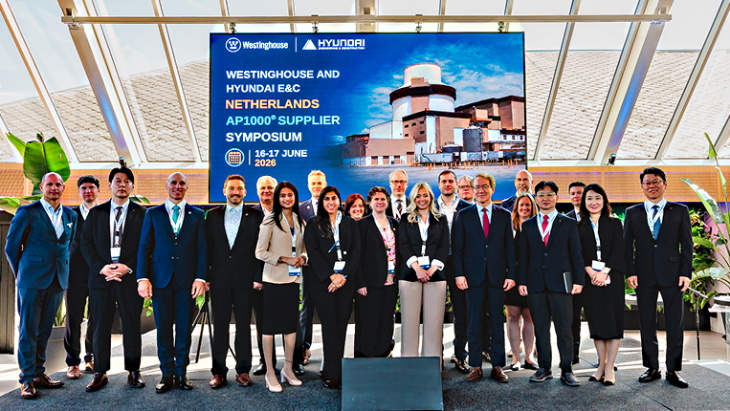
Westinghouse and South Korea's Hyundai Engineering & Construction have signed a contract to conduct Front-End Engineering Design (FEED) studies for two AP1000 nuclear reactors planned in the Netherlands. The work is split into two phases. Phase 1a runs location-independent, running parallel to the Dutch government's site selection process. Phase 1b begins once a preferred site is chosen and will be site-specific. Hyundai E&C will handle technical reviews of candidate sites, master planning, and project execution strategy, including licensing requirements, risk mitigation, and localisation approaches. The full FEED studies are expected to take 12 to 18 months.
Where this fits
This deal illustrates the reality of industrial nuclear construction: it requires sustained international cooperation, proven supply chains, and deep technical capability across multiple partners. The Netherlands is moving forward with firm, dispatchable generation to shore up its grid as it retires coal and gas. Westinghouse's choice to partner with Hyundai E&C, a firm with accumulated experience on large-scale nuclear projects, reflects the maturity and repeatability of modern reactor deployment. Australia, by contrast, remains legally barred from nuclear energy and has instead locked itself into a renewables-dependent grid with weather-dependent output, requiring either gas firming or vastly oversized storage infrastructure backed by China-sourced batteries and inverters.
What it means
Europe is moving to firm, low-emission power via a proven, technology-neutral path. Australia is betting the grid's reliability and its industrial cost competitiveness on renewables alone, knowing that path demands more firming gas, more transmission, more critical materials, and deeper dependence on China's supply chains. The Netherlands is choosing to compete on energy security. Australia is choosing constraint.
Go deeper on the numbers
The bigger picture
Energy security is national security. This connects to the wider case at Unprepared: Australia's dependence on a strategic rival, and how ready it is for the world that is coming.

Xi Jinping and the Purge That Built an Army
The PLA that Xi Jinping inherited in 2012 was modernising, and the one he commands in 2026 is transformed. Part IV of the Unprepared series.
Reported by World Nuclear News. Read the original report ↗
Related coverage
Paladin targets 2031 uranium production with $525m raising - Australian Resources & Investment
$3.9b uranium player Paladin looks to raise $525m - AFR
Data centres revive Coalition passion for nuclear power, but this time more expensive and even less realistic - Renew Economy
Russia proposes carbon credits framework for SMRs
The numbers, as they move
A short, sourced brief when the figures shift: a transmission blow-out, a supply-chain move, a milestone.