US Central Command has resumed strikes on IRGC targets around the Strait of Hormuz after Iranian attacks on shipping and US bases in Jordan, with Tehran vowing to block Gulf oil exports and Brent climbing sharply. Australia holds only weeks of domestic liquid fuel stocks and imports most refined product through Asian refineries fed by Gulf crude, so a sustained closure would test fuel resilience faster than any Indo-Pacific contingency. A protracted Middle East campaign also draws US carrier, munitions and ISR capacity away from the Western Pacific, weakening the deterrence assumptions underpinning Australian planning against Chinese coercion.
Defense News · 2026-09-01P1P2P7
August 2026
NAVAIR / Wikimedia Commons (Public domain) Major · Australia · Defence
Australia becomes the first foreign operator of the AIM-260A, a classified US air-to-air missile intended to close the range gap opened by China's PL-15 and PL-17, with integration planned across the Super Hornet, F-35A and Growler fleets. The A$736 million first tranche likely buys fewer than 100 rounds — enough to establish the capability but not a war stock — so magazine depth remains the open question. Early release of a program still withheld from other partners also signals a level of US technology-sharing confidence that contrasts with friction elsewhere in the alliance.
Defense News · 2026-08-10P6P7
NAVAIR / Wikimedia Commons (Public domain) Major · Australia · Defence
Australia has committed roughly A$736 million to acquire the AIM-260 JATM, becoming the only country outside the United States cleared to field the classified long-range air-to-air missile, with integration on the F/A-18F first, then the F-35A and EA-18G. The purchase addresses the RAAF's shrinking beyond-visual-range margin against PLAAF aircraft carrying the PL-15 and PL-17, where existing AMRAAM stocks are outranged. Access to a weapon still entering US service also signals a depth of technology-sharing that goes beyond routine FMS and offers a benchmark for what AUKUS Pillar 2-style cooperation can deliver in practice.
The War Zone · 2026-08-06P6P7
Paul Voller / Wikimedia Commons (CC BY 3.0) Major · Alliance
The United States will station around 2,300 personnel in Western Australia under what is described as a base arrangement, a substantial step beyond the rotational deployments that have defined the alliance's northern presence since 2011. Locating a force of this size on the Indian Ocean side of the continent aligns with Submarine Rotational Force–West at HMAS Stirling and signals that Australia's west coast is becoming a forward node for US undersea and maritime operations. It deepens the practical integration of the alliance while raising familiar questions about sovereign control, host-nation infrastructure costs, and Australia's exposure in any US-China contingency.
GNews: AUKUS · 2026-08-06P6P7
July 2026
U.S. D.O.D. graphic by Ron Stern. (RELEASED) / Wikimedia Commons (Public domain) Major · Australia · Defence
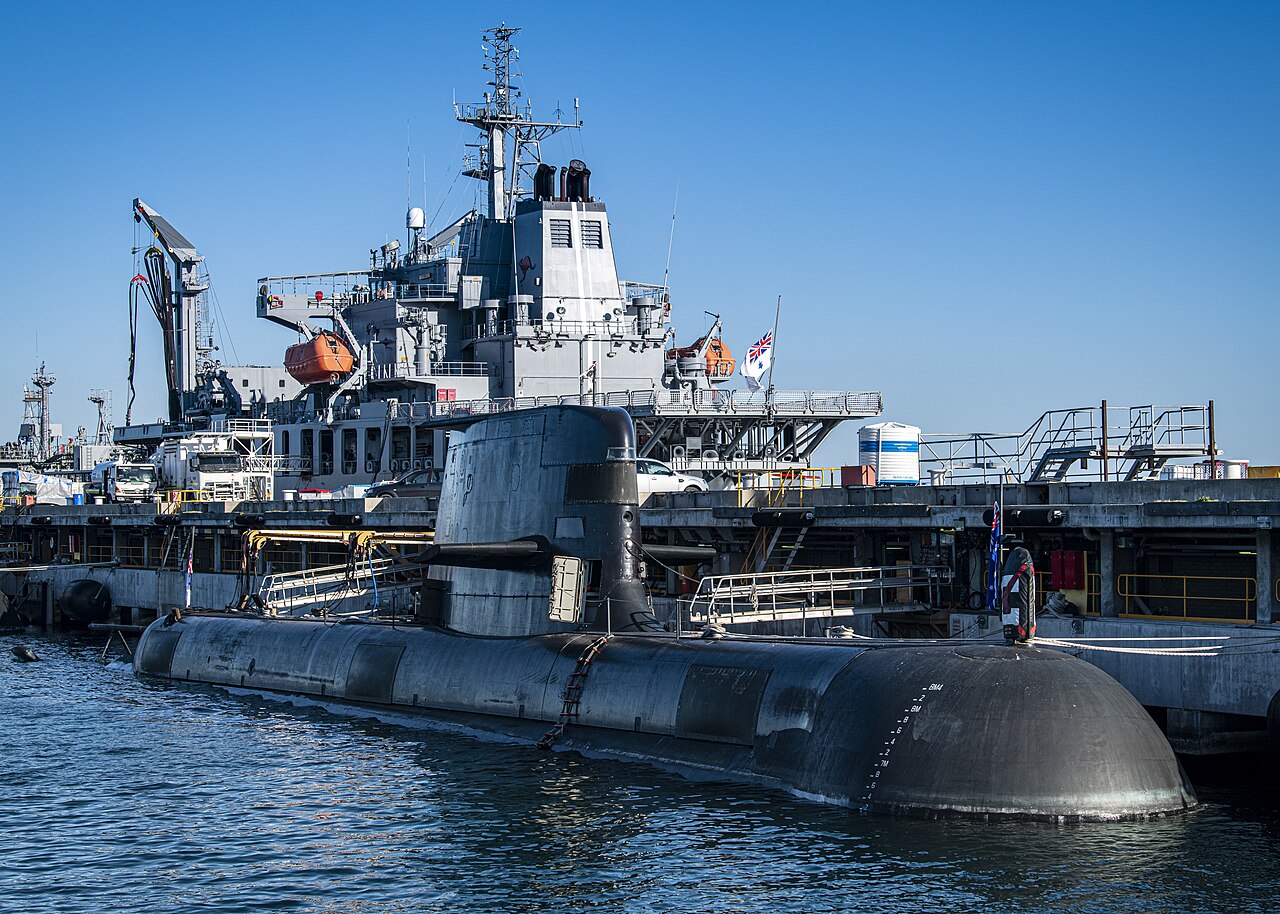
The Albanese Government's $4.6 billion AUKUS investment reaffirms Australia's commitment to acquiring Virginia-class and pillar II attack submarines, a cornerstone capability for Maritime Defence (Pillar 6) and alliance credibility (Pillar 7). This capital injection directly supports on-time delivery and operational submarine readiness, bolstering Australian deterrence and reducing strategic reliance on ageing Collins-class platforms.
China's successful validation of a long-range SLBM from a submerged platform closes a critical gap in its nuclear deterrent, achieving a credible second-strike capability that directly threatens Australian security and the stability of the Indo-Pacific. This development elevates pressure on Australia and its AUKUS partners to accelerate deterrent modernisation and intensifies the strategic urgency of the attack-submarine program, while simultaneously raising the threshold for conventional escalation in Taiwan and maritime scenarios.
ASPI The Strategist · 2026-07-08P6P7P8
U.S. Navy / MC2 Jeanette Mullinax (public domain) Major · China · Military
China's SLBM test in the Pacific demonstrates accelerating development of survivable sea-based nuclear deterrent (Type 094/096), directly narrowing Australia's strategic cushion and eroding AUKUS-allied undersea dominance upon which Australia's maritime defence and alliance cohesion depend. This capability expansion—operating closer to Australian waters and regional allies—raises the threshold for allied intervention in Taiwan scenarios and signals China's intent to deny sea control in the Indo-Pacific, directly challenging Pillar 6 (Maritime Defence) and Pillar 8 (Northern Arc) preparedness.