Recurrent wins federal approval for NSW solar and battery project
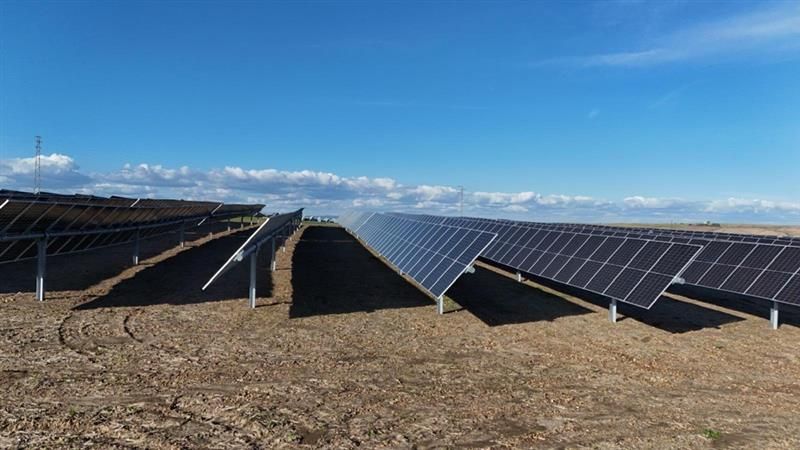
Recurrent Energy has received federal environmental approval under the EPBC Act for the Sundown project in NSW's New England region. The facility combines 360 MW of solar with 150 MW / 600 MWh of battery storage across a 525-hectare site near Inverell, connecting to the NEM via an existing 330 kV transmission line. The company claims the project will meet the annual electricity needs of around 176,000 households and support peak demand.
Where this fits
This project exemplifies the renewables-plus-battery pathway now driving Australian generation investment. The 600 MWh battery is modest relative to the solar output, enough to shift a few hours of afternoon generation to evening peak, not to cover a windless night or multi-day weather trough. That gap will require either gas backup, demand destruction, or an oversized transmission network to import firm power from distant sources. The supply chain for both the 660,000 solar panels and the lithium-ion battery is dominated by China, tying Australia's grid stability to overseas manufacturing and mineral-processing capacity that sits beyond sovereign control.
What it means
Australia is building a grid that works well on sunny, breezy afternoons and requires external firming on calm, dark evenings. Each large solar-plus-battery project deepens that structural dependency on gas and on China's supply chains. The alternative, a firm, energy-dense, domestically controllable fleet anchored by nuclear, remains legally foreclosed. Recurrent's project clears regulatory hurdles because solar and batteries are policy-aligned and capital-efficient on a per-megawatt basis. That efficiency obscures the whole-system cost of weather dependence and offshore manufacturing control, neither of which the environmental approvals process measures.
By the numbers
at ~A$1100–1600/kW installed. Source: CSIRO GenCost 2024-25. Indicative.
at a ~24% capacity factor, and only when the sun shines, so it still needs firming.
~80% of modules are China-made. Source: IEA solar supply-chain data.
enough for 0–1 TWh a year of firm, always-on power, generating for ~60 years. Source: CSIRO GenCost 2024-25 (A$8.5–13.2bn/GW), IAEA capacity factor.
Figures are indicative conversions from the article's stated quantity using published cost, material and capacity factors (CSIRO GenCost, BNEF, IEA, IAEA). Ranges, not precise forecasts.
at ~A$600–1000/kWh installed. Source: BNEF, CSIRO GenCost 2024-25. Indicative.
of average national (NEM) demand if fully dischargeable, then it needs recharging. Storage shifts power, it does not generate it.
lithium, graphite, nickel, copper and cobalt (~60 t lithium content). Replaced roughly every 12 years. Source: IEA, Argonne GREET. Indicative.
~75% of cells are China-made. Source: IEA cell-manufacturing share.
enough for 0–1 TWh a year of firm, always-on power, generating for ~60 years. Source: CSIRO GenCost 2024-25 (A$8.5–13.2bn/GW), IAEA capacity factor.
Figures are indicative conversions from the article's stated quantity using published cost, material and capacity factors (CSIRO GenCost, BNEF, IEA, IAEA). Ranges, not precise forecasts.
Go deeper on the numbers
The bigger picture
Energy security is national security. This connects to the wider case at Unprepared: Australia's dependence on a strategic rival, and how ready it is for the world that is coming.
Reported by PV Magazine Australia. Read the original report ↗
Related coverage
The Four-Hour Problem: Why HiTHIUM Is Betting on Eight-Hour Batteries for Australia’s Grid
Rare, state-owned wind farm clears one of “most complex” grid connection hurdles - Renew Economy
Big batteries soak up record amounts of energy as big solar floods the grid – but curtailment still bites
Home battery volumes on rise as rebate tally reaches 600,000
The numbers, as they move
A short, sourced brief when the figures shift: a transmission blow-out, a supply-chain move, a milestone.