Construction of Chinese HTGR begins
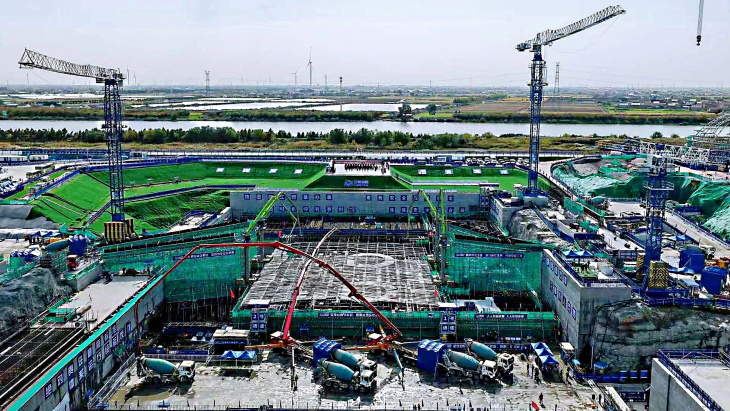
China's state nuclear corporation began pouring concrete for the first unit of a high-temperature gas-cooled reactor at Jiangsu Xuwei in Lianyungang. The plant will house three reactors: two 1,208 MW pressurised water reactors and one 660 MW HTGR, jointly developed by China National Nuclear Corporation and Tsinghua University. The HTGR is designed for 60 years of operation. First concrete for the two conventional reactors was poured in January 2026. The project is one of 11 reactors approved by China's State Council in August 2024.
Where this fits
This demonstrates China's systematic investment in firm, dispatchable nuclear capacity at scale while Australia remains locked out of that technology by law. The HTGR is an advance in reactor design: HTGRs operate at higher temperatures, enabling industrial heat applications and potentially grid-scale hydrogen production. China is securing both energy density and industrial decarbonisation pathways. Australia's energy transition, by contrast, is built on renewables with gas firming and battery backing: weather-dependent output paired with a supply chain (panels, batteries, inverters, rare-earth processing) owned by Beijing, and no firm alternative permitted at home.
What it means
Australia is outsourcing both energy security and technology development to a strategic rival while banning the one firm, low-emission, domestically-licensable power source that could reduce that dependence. Each reactor China commissions is a data point in diverging energy futures: one building resilient, firm capacity with indigenous technical capability; the other betting stability on intermittent resources and imported hardware, backed by gas, on a grid designed for no other choice.
By the numbers
at ~A$2000–3200/kW installed. Source: CSIRO GenCost 2024-25. Indicative.
at a ~38% capacity factor, and only when the wind blows, so it still needs firming.
enough for 1–2 TWh a year of firm, always-on power, generating for ~60 years. Source: CSIRO GenCost 2024-25 (A$8.5–13.2bn/GW), IAEA capacity factor.
Figures are indicative conversions from the article's stated quantity using published cost, material and capacity factors (CSIRO GenCost, BNEF, IEA, IAEA). Ranges, not precise forecasts.
Go deeper on the numbers
The bigger picture
Energy security is national security. This connects to the wider case at Unprepared: Australia's dependence on a strategic rival, and how ready it is for the world that is coming.

The Factory Floor
In 2024, China built over a thousand commercial vessels. The United States built eight. Part V of the Unprepared series.
Reported by World Nuclear News. Read the original report ↗
Related coverage
Rooppur nuclear plant feeds 350MW into national grid for the first time - The Daily Star
Energy crisis reinforces comeback of nuclear power, says IEA
Bangladesh 1st nuke power plant connects to national grid - Khmer Times
Nuclear Finance is Running Out of Excuses
The numbers, as they move
A short, sourced brief when the figures shift: a transmission blow-out, a supply-chain move, a milestone.