Local developer puts huge wind and battery proposal forward for federal green tick
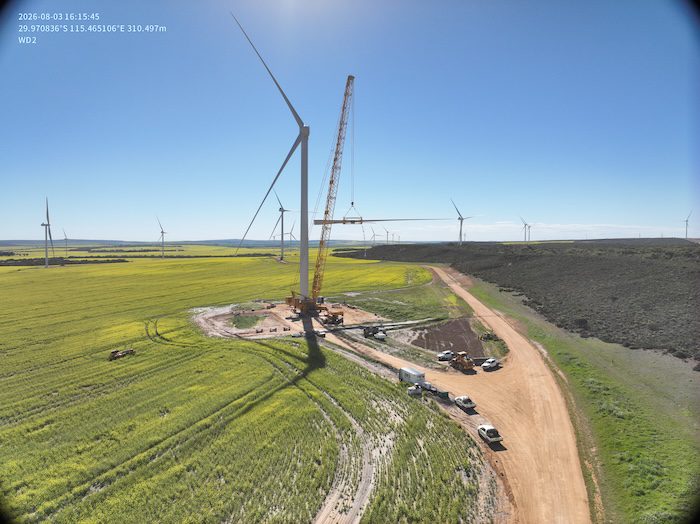
Lacour Energy has referred a 736 MW wind farm plus 500 MW battery storage project in Western Australia's Wheatbelt for federal environmental assessment under the EPBC Act. The West Arthur Energy project, proposed 40 km east of Collie, would include up to 92 turbines, 4,000 MWh of battery capacity, and transmission infrastructure to connect to the South West Interconnected System. The referral follows state approval submission and the project's inclusion on federal Labor's National Renewable Energy Priority List, which fast-tracks assessment.
Where this fits
This is a data point in a pattern of large-scale, weather-dependent renewable investment without commensurate firm dispatchable power. The 500 MWh battery, sufficient to firm the wind farm for roughly 40 minutes at full discharge, sits at the core of the cost and reliability story. A battery of this scale will require vast quantities of lithium, cobalt and nickel, 60, 80 per cent of which Australia either imports or sources through supply chains ending in China. The real question is not whether 736 MW of wind capacity gets built, but whether 4,000 MWh of storage is enough to smooth the SWIS when wind output falls, and what the bill is when it is not.
What it means
Australia's grid is being rebuilt around renewable nameplate capacity and battery duration measured in hours, not days or seasons. When output falls short, the system still needs gas or interstate transmission to avoid load shedding. Neither option is a substitute for firm, long-lived generation; both carry material, cost and sovereignty penalties that the renewables case does not price in. A nuclear alternative, banned by law, would supply the same or greater capacity with one per cent of the battery material footprint and no weather risk.
By the numbers
at ~A$2000–3200/kW installed. Source: CSIRO GenCost 2024-25. Indicative.
at a ~38% capacity factor, and only when the wind blows, so it still needs firming.
enough for 1–2 TWh a year of firm, always-on power, generating for ~60 years. Source: CSIRO GenCost 2024-25 (A$8.5–13.2bn/GW), IAEA capacity factor.
Figures are indicative conversions from the article's stated quantity using published cost, material and capacity factors (CSIRO GenCost, BNEF, IEA, IAEA). Ranges, not precise forecasts.
at ~A$600–1000/kWh installed. Source: BNEF, CSIRO GenCost 2024-25. Indicative.
of average national (NEM) demand if fully dischargeable, then it needs recharging. Storage shifts power, it does not generate it.
lithium, graphite, nickel, copper and cobalt (~400 t lithium content). Replaced roughly every 12 years. Source: IEA, Argonne GREET. Indicative.
~75% of cells are China-made. Source: IEA cell-manufacturing share.
enough for 1–4 TWh a year of firm, always-on power, generating for ~60 years. Source: CSIRO GenCost 2024-25 (A$8.5–13.2bn/GW), IAEA capacity factor.
Figures are indicative conversions from the article's stated quantity using published cost, material and capacity factors (CSIRO GenCost, BNEF, IEA, IAEA). Ranges, not precise forecasts.
Go deeper on the numbers
The bigger picture
Energy security is national security. This connects to the wider case at Unprepared: Australia's dependence on a strategic rival, and how ready it is for the world that is coming.

Xi Jinping and the Purge That Built an Army
The PLA that Xi Jinping inherited in 2012 was modernising, and the one he commands in 2026 is transformed. Part IV of the Unprepared series.
Reported by RenewEconomy. Read the original report ↗
Related coverage
Multi-year coal plant extensions needed to stop power price spikes - AFR
260 MW solar project part of AirTrunk, European Energy deal
What grid-forming kit are Australia’s largest solar–BESS hybrids using?
New four-hour battery storage proposal seeks federal green tick for Australia’s most renewable state grid
The numbers, as they move
A short, sourced brief when the figures shift: a transmission blow-out, a supply-chain move, a milestone.