X-energy selects Fluor for second Xe-100 project
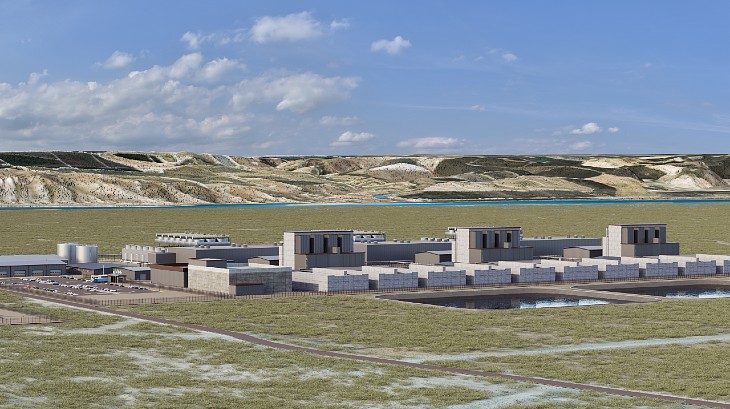
Fluor Corporation has been contracted to provide design and engineering services for a second advanced reactor project: a proposed 320 MWe facility at Energy Northwest's Cascade site in Washington state, featuring four of X-energy's Xe-100 high-temperature gas-cooled reactors. This follows Fluor's April contract to support X-energy's first Xe-100 deployment at Dow's Texas operations under the US Department of Energy's Advanced Reactor Demonstration Program. The agreement is structured to capture learnings from the first project and apply them to the second, with the stated aim of driving cost and schedule reductions through standardisation.
Where this fits
This is a data point in the firm-power case. The Xe-100 is a small modular reactor designed to displace coal and gas at industrial heat sites and generate dispatchable electricity. Two commercial projects under government support represent the kind of fleet repetition that reduces unit costs and builds supply-chain maturity. The contract commitment by Fluor, a tier-one engineering firm, signals confidence in the technology's commercial pathway. Australia has banned this technology by law, while continuing to build weather-dependent renewables that require gas firming and transmission overbuilds.
What it means
Australia is outsourcing its energy-security choices to the United States. The US is moving to underwrite advanced nuclear deployment at scale; Australia is locked into solar, wind and batteries, whose supply chains are dominated by China and whose output requires gas backup. The cost trajectory of firm, dispatchable, low-emissions generation is being proven in America. Australia will not benefit from that learning curve.
By the numbers
at ~A$2000–3200/kW installed. Source: CSIRO GenCost 2024-25. Indicative.
at a ~38% capacity factor, and only when the wind blows, so it still needs firming.
enough for 0–1 TWh a year of firm, always-on power, generating for ~60 years. Source: CSIRO GenCost 2024-25 (A$8.5–13.2bn/GW), IAEA capacity factor.
Figures are indicative conversions from the article's stated quantity using published cost, material and capacity factors (CSIRO GenCost, BNEF, IEA, IAEA). Ranges, not precise forecasts.
Go deeper on the numbers
The bigger picture
Energy security is national security. This connects to the wider case at Unprepared: Australia's dependence on a strategic rival, and how ready it is for the world that is coming.

The Factory Floor
In 2024, China built over a thousand commercial vessels. The United States built eight. Part V of the Unprepared series.
Reported by World Nuclear News. Read the original report ↗
Related coverage
Rooppur nuclear plant feeds 350MW into national grid for the first time - The Daily Star
Energy crisis reinforces comeback of nuclear power, says IEA
Bangladesh 1st nuke power plant connects to national grid - Khmer Times
Nuclear Finance is Running Out of Excuses
The numbers, as they move
A short, sourced brief when the figures shift: a transmission blow-out, a supply-chain move, a milestone.