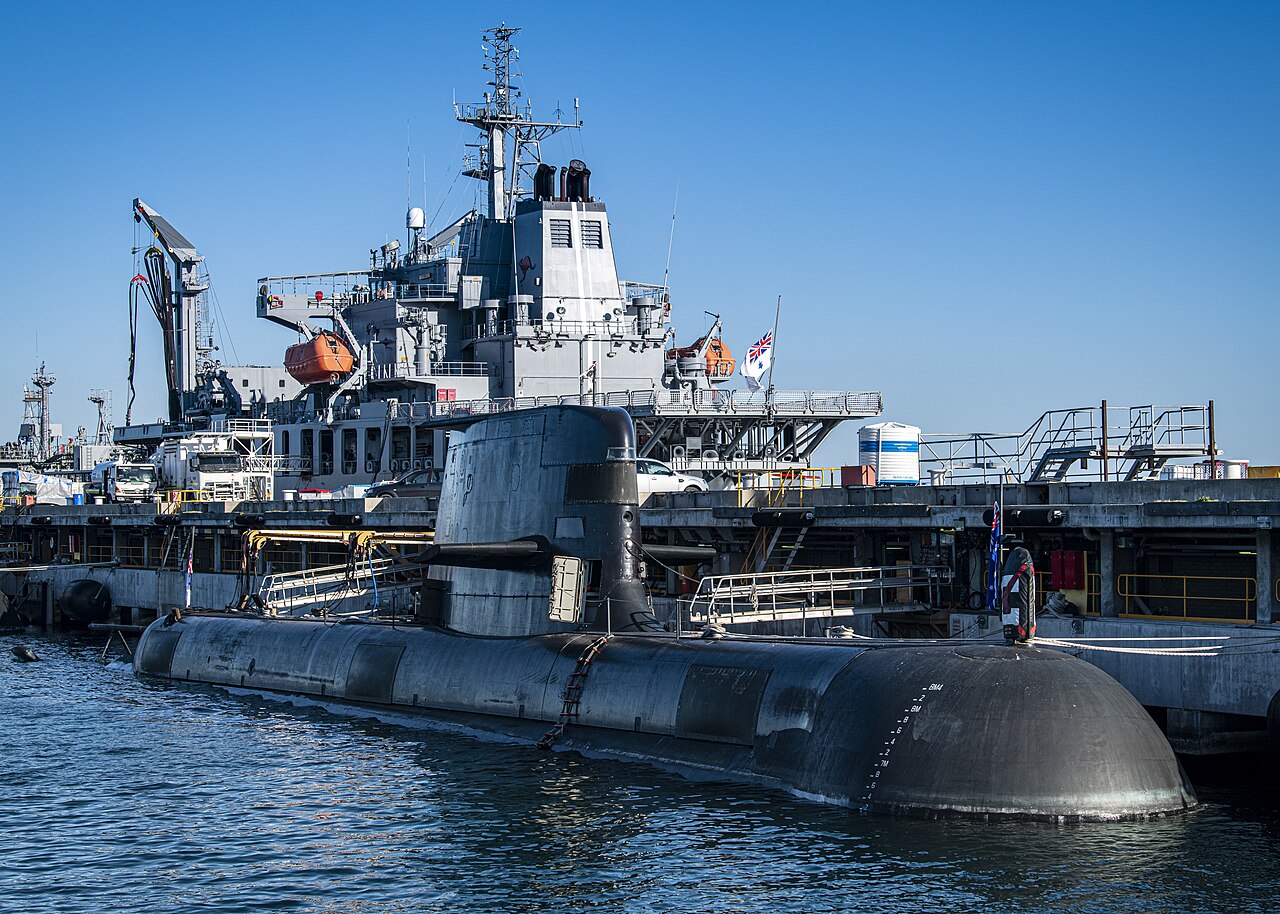
US will send only used nuclear submarines to Australia under amended AUKUS defence deal - France 24
GNews: nuclear submarine · 2026-05-31source ↗P6P7 The amended AUKUS deal confirming delivery of used US nuclear submarines is a concrete material development directly advancing Australia's maritime defence capability and alliance credibility with the US. This reduces strategic risk from both American withdrawal and prolonged conventional submarine vulnerability, though 'used' vessels may imply capability gaps or cost/schedule trade-offs compared to original SSN(X) plans.
Australia to buy only secondhand nuclear subs from US in major Aukus switch – as it happened - The Guardian
GNews: AUKUS · 2026-05-31source ↗P6P7 This shift from building Attack-class submarines to acquiring secondhand US Virginia-class boats materially accelerates Australia's operational submarine capability timeline and reduces sovereign industrial risk, directly strengthening Pillar 6 (Maritime Defence) and deepening Pillar 7 (Alliance) commitment by the US. The change also signals renewed AUKUS viability after prior programme turbulence, substantially reducing near-term risk of alliance fragmentation and improving Australia's ability to contest the Indo-Pacific against PLA expansion.
Australia to buy only secondhand nuclear subs from US in major Aukus switch – as it happened - The Guardian
GNews: nuclear submarine · 2026-05-31source ↗P6P7 Australia's shift to secondhand US submarines accelerates AUKUS delivery and reduces sovereign industrial-base requirements, strengthening Maritime Defence (Pillar 6) capability timelines while potentially lowering acquisition costs relative to original SSN-AUKUS build program. This reinforces the Alliance pillar (7) by demonstrating US commitment to near-term Australian deterrent capability in the Indo-Pacific amid PLA naval expansion.
AUKUS Partners Change Plan On Submarines, Mull Drone Fielding - navalnews.com
GNews: AUKUS · 2026-05-31source ↗P6P7 AUKUS submarine plan changes directly affect Australia's Maritime Defence pillar (6) and Alliance pillar (7). Submarine capability delays extend Australia's undersea-warfare gap during rising PLA naval challenge, weakening deterrence during Taiwan contingencies and increasing reliance on US guarantees at a time when partner commitment signals are mixed.
Drones and second-hand submarines: US 'grateful' for Australia as latest AUKUS details unveiled - SBS Australia
GNews: nuclear submarine · 2026-05-31source ↗P6P7 AUKUS submarine procurement represents a concrete advance in Australia's maritime defence capability and deepens US alliance commitment, directly addressing the submarine gap identified as critical to Indo-Pacific deterrence. The explicit US gratitude and disclosure of implementation details signal alliance solidification and reduction of withdrawal risk during a period of great-power competition.
Allies guilty of ‘freeloading’ will be penalised, says US war secretary - The Times
GNews: allied defence · 2026-05-30source ↗P7P2 US Defence Secretary signalling enforcement of NATO/ally defence spending commitments indicates sustained pressure on allied nations—including Australia—to increase defence investment and demonstrate strategic weight. This reinforces alliance expectations and reduces risk of unilateral US disengagement, bolstering Pillar 7 (Alliance) commitment architecture.
Hegseth says 'no state, including China,' to dominate Asia - DW.com
GNews: China military · 2026-05-30source ↗P7P8 Hegseth's statement affirms US commitment to preventing Chinese regional hegemony in the Indo-Pacific, reinforcing the alliance pillar and reducing near-term scenarios of US strategic disengagement that would expose Australia. This signals continuation of the balance-of-power strategy underpinning AUKUS and Australia's own defence posture.
Shangri-La: Hegseth Calls on Western Pacific Allies to Maintain Military Strength, 'We Need Partners, Not Protectorates' - USNI News
GNews: US alliance Pacific · 2026-05-30source ↗P7P8 Hegseth's emphasis on 'partners, not protectorates' signals US commitment to burden-sharing and sustained alliance engagement in the Indo-Pacific, directly relevant to Australia's reliance on the US alliance (Pillar 7) and regional stability. The framing reinforces expectations that Australia must maintain independent military capability rather than devolve to US protection, supporting the strategic rationale for AUKUS and autonomous defence investment.
Aukus: US, UK and Australia to develop underwater drone technology - BBC
GNews: AUKUS UK Britain · 2026-05-30source ↗P6P7P8 AUKUS underwater drone development represents a concrete trilateral capability initiative that strengthens Australian maritime defence and deepens US-UK-Australia technological integration. This reinforces the alliance pillar and enhances asymmetric undersea capability against the PLA's expanding submarine fleet, directly supporting Defence pillar 6 (Maritime Defence) and pillar 7 (Alliance).
Pete Hegseth warns Chinese military threatens 'balance of power' in the Pacific - SBS Australia
GNews: China military · 2026-05-30source ↗P6P7P8 A statement by the US Secretary of Defense affirming that Chinese military growth threatens the Pacific balance-of-power directly reinforces the strategic rationale for AUKUS and the US alliance posture toward Australia, while validating the core threat assumptions underpinning Australian defence planning. This signals continued US commitment to Pacific security but also underscores the urgency of Australian capability development and interoperability, particularly in maritime and Northern Arc domains.
Cutting-edge underwater tech for AUKUS forces to be developed through landmark partnership - GOV.UK
GNews: AUKUS UK Britain · 2026-05-30source ↗P6P7P3 AUKUS trilateral technological development for undersea capabilities directly strengthens Australia's maritime defence posture and operational submarine effectiveness, core to the AUKUS pillar. The partnership demonstrates sustained US-UK commitment to AUKUS implementation and reduces risk of alliance fracture, critical given Australia's dependence on advanced submarine and allied force interoperability in the Indo-Pacific.
Japan's defence minister denies militarism and criticises China's 'huge arsenal' - BBC
GNews: China military · 2026-05-30source ↗P5P7P8 Japanese defence minister's explicit critique of China's military buildup and rebuttal of militarism charges signals regional alignment and strengthens the case for Indo-Pacific security coordination, which anchors Australia's Pillar 7 alliance architecture. Japan's public assertion reinforces the Northern Arc coalition (Pillar 8) framing and supports decoupling narratives (Pillar 5) by positioning Japan as a security partner on accelerating China military expansion.
US not 'turning back' on Asia allies, but expects them to boost defence, says Hegseth - BBC
GNews: allied defence · 2026-05-30source ↗P7P2 Hegseth's statement that the US is not withdrawing from Asia but expects allies to increase defence contributions signals continued US commitment to the region and AUKUS, while placing direct pressure on Australia to elevate defence spending as a condition of sustained partnership. This is a pivot-point signal for Australia's Pillar 7 (Alliance) credibility and Pillar 2 (Fiscal Engine) allocation: Australia must demonstrate willingness to co-invest to maintain US strategic confidence.
Hegseth Outlines U.S. Vision For Indo-Pacific at Annual Asia Defense Summit - U.S. Department of War (.gov)
GNews: Indo-Pacific · 2026-05-29source ↗P7P8 A US Defense Secretary articulating a formal Indo-Pacific vision at a major defence summit signals continued US commitment to regional architecture and alliance partnerships, directly bearing on Australia's pillar-7 (Alliance) confidence and pillar-8 (Northern Arc) security posture. The articulation of strategy reduces uncertainty around American withdrawal scenarios and reinforces the AUKUS/Pacific alliance framework upon which Australian preparedness depends.
Quad nations step up Indo-Pacific push with new initiatives - Defense News
GNews: Quad security · 2026-05-29source ↗P7P8 Quad coordination initiatives strengthen the Alliance pillar (7) and Northern Arc partnerships (8), reinforcing Australia's strategic depth in the Indo-Pacific and signalling sustained US commitment to regional security. Concrete Quad actions reduce risk of American strategic retreat and improve deterrence posture relevant to Taiwan contingency and Chinese military ambition.
The Quad meets, Fiji waits outside
Devpolicy Blog · 2026-05-29source ↗P7P8 The article highlights institutional exclusion of Pacific island nations from Quad decision-making on regional security, potentially weakening great-power coordination and creating legitimacy gaps in Indo-Pacific arrangements that Australia depends on. This tension between Quad strategic interests and Pacific sovereignty concerns directly affects Pillar 7 (Alliance cohesion) and Pillar 8 (Northern Arc political stability), and may accelerate alternative regional security architectures that fragment Australia's strategic environment.
Sharp China: Social Mobility and Hukou Reform; US Halts Taiwan Arms Sales?; Ongoing Pressure on Japan; An American Xinhua Journalist Arrested
Sinocism · 2026-05-28source ↗P5P7P8 The reported US pause on Taiwan arms sales and indications of US-China investment board negotiations suggest potential weakening of the US security commitment to Taiwan, directly threatening Australian regional stability and AUKUS credibility. China's restrictions on AI talent export and capital controls, combined with rare earth shipment restrictions on Japan, indicate Beijing is consolidating strategic leverage through technology denial and critical-mineral weaponisation—both high-stakes decoupling moves affecting Australia's technology and resource security.
Taiwan Conflict Could Trigger Nuclear Crisis Between United States and China - Modern Diplomacy
GNews: Taiwan conflict · 2026-05-28source ↗P7P8 A Taiwan conflict scenario involving nuclear escalation between US and China directly threatens the Alliance pillar (7) and Northern Arc regional stability (8), core to Australian strategic deterrence. The article's focus on nuclear crisis potential elevates scenario risk assessment and reinforces the strategic imperative for AUKUS deepening and autonomous Australian capability to hedge against US-China confrontation.
US-China conflict over Taiwan risks a nuclear escalation, study finds - Reuters
GNews: Taiwan conflict · 2026-05-28source ↗P6P7P8 A Reuters study confirming nuclear escalation risk in a Taiwan conflict scenario directly strengthens the case for Australian maritime defence posture (Pillar 6) and alliance credibility stress-testing (Pillar 7). This reinforces Taiwan kinetic and nuclear-use scenario planning, which are core drivers of AUKUS capability acceleration and Northern Arc strategic positioning.
China Protests After Western Frigate Sails in South China Sea - dominotheory.com
GNews: PLA navy · 2026-05-28source ↗P6P7P8 Western freedom-of-navigation operations in the South China Sea reflect ongoing great-power competition for maritime control in zones adjacent to Australia's strategic interests and AUKUS operations. China's protest signals escalating tensions over disputed waters that could constrain Australia's own naval operations and alliance coordination in the Indo-Pacific.
US-China tensions over Taiwan may spiral towards nuclear escalation, study warns - WION
GNews: Taiwan conflict · 2026-05-28source ↗P7P8 The study's warning of nuclear escalation in a Taiwan conflict directly affects Australia's Alliance pillar (US credibility, extended deterrence) and Northern Arc security architecture. It strengthens the case for Australian strategic hedging, AUKUS deepening, and independent deterrent posture development, but signals increasing downside tail-risk to the US-China competition model Australia has relied upon.
Any conflict over Taiwan would risk US-China nuclear escalation: Study - The Straits Times
GNews: Taiwan conflict · 2026-05-28source ↗P7P8 A study affirming nuclear escalation risk in Taiwan conflict directly elevates the stakes for Australia's alliance dependency (Pillar 7) and Indo-Pacific security architecture (Pillar 8), forcing reassessment of alliance resilience and contingency planning. The finding underscores that Australia cannot assume US intervention in Taiwan is cost-free or certain, pressuring strategic decoupling and autonomous defence capability development.
Conflict over Taiwan could risk US-China nuclear crisis, major study warns - The Independent
GNews: Taiwan conflict · 2026-05-28source ↗P7P8 Analysis of US-China nuclear escalation risks over Taiwan directly affects Australia's Alliance pillar and Northern Arc security calculus, as it frames the worst-case outcome of the primary regional flashpoint. The study's findings on nuclear crisis pathways should inform Australian contingency planning, AUKUS integration depth, and strategic communications about deterrence credibility in the Indo-Pacific.
QUAD to launch maritime surveillance initiative in Indo-Pacific - daily-sun.com
GNews: Quad security · 2026-05-28source ↗P6P7P8 QUAD maritime surveillance represents operational deepening of the US-led alliance architecture in the Indo-Pacific, directly supporting Australia's maritime defence posture and alliance resilience. This concrete initiative strengthens Australia's ability to monitor PLA activity and reinforces the pacific_security_pact scenario while raising costs of kinetic action against Taiwan.
Japan Extends SEA Military Presence Via Balikatan Exercise
Asia Sentinel · 2026-05-28source ↗P6P7P8 Japan's extended military presence in Southeast Asia via the Balikatan exercise strengthens the allied network in the Indo-Pacific, directly supporting Australia's Pillar 7 (Alliance) and Pillar 8 (Northern Arc) strategic posture against Chinese power projection. This demonstrates coordinated allied presence-building in the region and raises the cost of Chinese military coercion in the Taiwan Strait and broader Pacific.
Quad ministers stress maritime security, Hormuz diplomatic solution - Yeni Şafak English
GNews: Quad security · 2026-05-26source ↗P6P7P8 Quad ministerial commitment to maritime security and diplomatic solutions for Hormuz closure reinforces allied coordination on critical chokepoints and energy security vital to Australia. The emphasis on diplomatic resolution reduces kinetic conflict risk in a region critical to Australian trade and energy imports, supporting alliance cohesion and Indo-Pacific stability mechanisms.
Quad ministers announce new Indo-Pacific initiatives on maritime security and energy - AP News
GNews: Quad security · 2026-05-26source ↗P5P6P7P8 Quad ministerial alignment on maritime security and energy initiatives reinforces the US-led alliance architecture that Australia depends upon for Indo-Pacific strategic deterrence and energy supply resilience. Concrete initiatives in these domains strengthen Pillar 7 (Alliance) and Pillar 8 (Northern Arc) positioning, though without explicit Australian capability or spending commitments the materiality is limited.
Chinese Carrier Liaoning Near Philippines, USS George Washington Leaves Yokosuka Ahead of Spring Patrol - USNI News
GNews: PLA navy · 2026-05-26source ↗P6P7P8 Chinese carrier activity near the Philippines and concurrent US carrier deployment demonstrate intensifying great-power competition in waters critical to Australian trade and security, directly affecting the credibility of US extended deterrence in the Indo-Pacific. This pattern of Chinese power projection toward Taiwan and increased US naval operations raises both the salience of the US alliance and the risk of kinetic escalation in Australia's strategic neighborhood.
Rubio unveils Quad initiatives on maritime, energy security - Anadolu Ajansı
GNews: Quad security · 2026-05-26source ↗P6P7P8 Rubio's Quad initiatives on maritime and energy security signal sustained US commitment to Indo-Pacific strategic coordination, reinforcing the alliance pillar and regional security architecture. This supports Australia's core strategic dependencies on US presence and Quad-led regional balancing against Chinese power expansion.
US, Quad partners launch maritime security initiatives for Indo-Pacific - Türkiye Today
GNews: Quad security · 2026-05-26source ↗P6P7P8 Quad maritime security initiatives reinforce US commitment to Indo-Pacific stability and signal alliance coordination on freedom of navigation and strategic chokepoints, directly relevant to Australia's maritime defence posture and alliance resilience. The initiative strengthens the institutional framework underpinning Australian security strategy in the Northern Arc and against disruption scenarios like Hormuz closure.
How US Cable Security Policy Is Restructuring Indo-Pacific Digital Infrastructure - Geopolitical Monitor
GNews: Indo-Pacific · 2026-05-26source ↗P5P7P8 US cable security policy represents concrete alliance action to restructure critical Indo-Pacific digital infrastructure away from Chinese control and dependency, directly supporting Australia's strategic decoupling and alliance resilience. This development strengthens Australian digital sovereignty and reduces vulnerability to Chinese leverage over undersea cable networks that carry financial, defence, and intelligence traffic.
Quad ministers push Indo-Pacific security and supply chain agenda in Delhi - The Indian Sun
GNews: Quad security · 2026-05-26source ↗P7P5P8 Quad ministerial engagement on Indo-Pacific security and supply-chain resilience reinforces the multilateral alliance architecture (Pillar 7) that Australia depends on to counter Chinese regional dominance and supports strategic decoupling (Pillar 5) through coordinated supply-chain hardening. The focus on the Northern Arc (Pillar 8) and India's role as a counterweight to China's leverage strengthens Australia's strategic positioning.
Assumptions, not reality: Australia’s Indian Ocean challenge
Perth USAsia Centre · 2026-05-26source ↗P6P7P8 The article flags a critical reassessment of Australian assumptions about Indian Ocean security—a region integral to Australia's resource sovereignty, energy transit, and alliance posture. However, the text provided is largely a header/announcement with minimal substantive detail on what specific assumptions are being challenged or what policy shifts are recommended.
Old Wounds, New Deals
Asia Sentinel · 2026-05-26source ↗P1P5P7 South Korea and Japan's energy swap arrangement demonstrates a strategic decoupling mechanism within a critical allied region, signalling resilience against Hormuz-driven energy shock scenarios that Australia faces as a fuel-import-dependent nation. This regional precedent is material to Australian contingency planning for energy security and suggests viable diplomatic pathways for managing Middle Eastern supply disruptions through intra-Pacific energy cooperation.
Can the Quad keep momentum without a leaders’ summit? - Lowy Institute
GNews: Quad security · 2026-05-25source ↗P7P8 The Quad's ability to maintain momentum without in-person leaders' summits directly tests the institutional resilience of Australia's primary Indo-Pacific alliance architecture amid US strategic attention constraints. Degradation of Quad coordination protocols weakens Australia's position in the Northern Arc and reduces deterrent effect on China's regional ambitions.
Quad foreign ministers hold talks in New Delhi on Indo-Pacific cooperation - ABC News - Breaking News, Latest News and Videos
GNews: Quad security · 2026-05-25source ↗P7P8 Quad ministerial engagement in New Delhi reaffirms the quadrilateral alliance's cohesion on Indo-Pacific cooperation, strengthening the institutional framework that underpins Australia's alliance strategy against Chinese regional assertiveness. This signals sustained US commitment to the region and reinforces the alliance pillar critical to Australia's strategic posture.